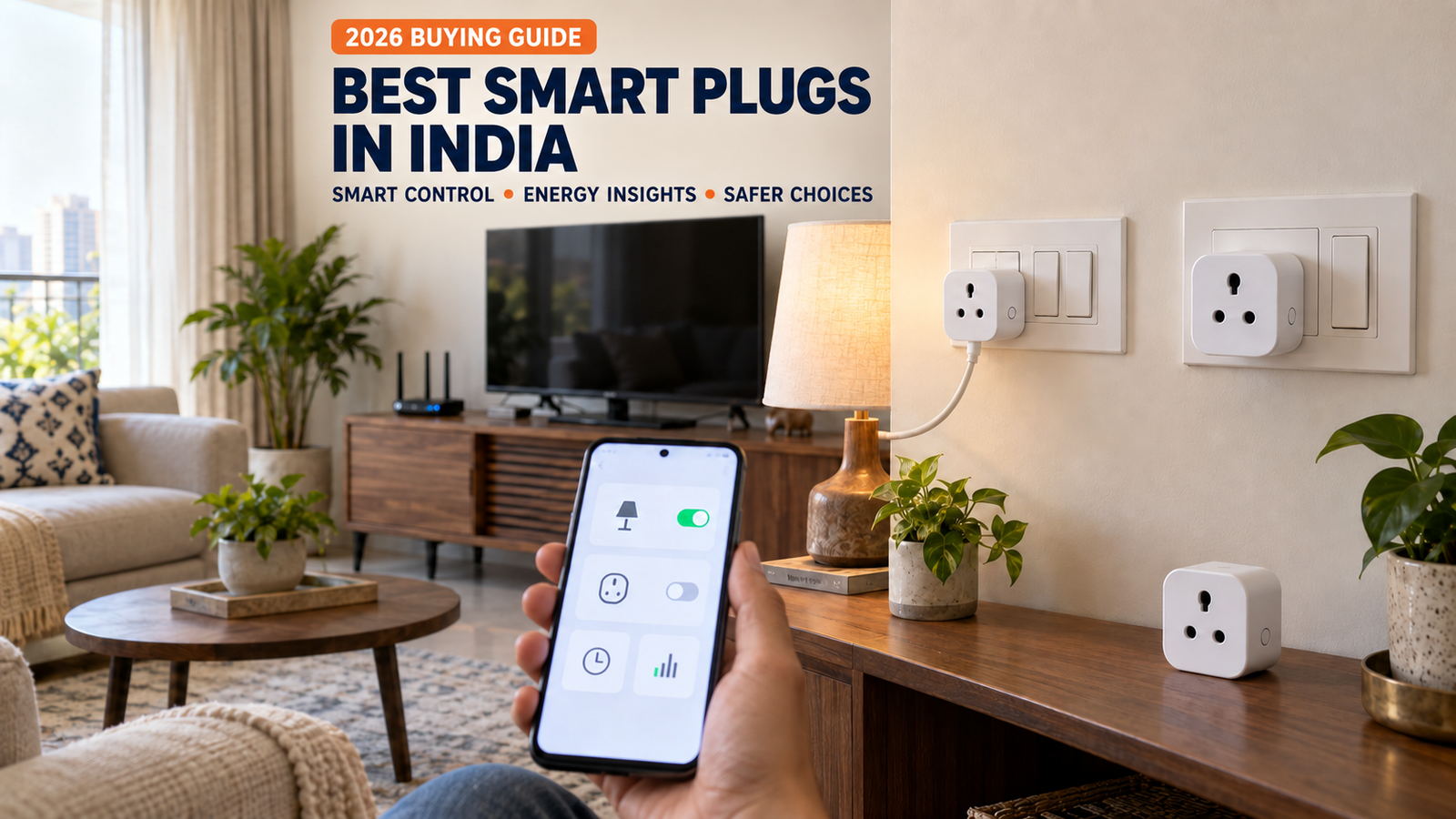
Smart plugs can add scheduling, remote switching, voice control and, on some models, energy tracking to an ordinary appliance. But the best smart plugs in India are not simply the cheapest products or the ones with the highest ampere rating. The plug must physically fit the socket, suit the appliance and remain within every limit and restriction stated by its manufacturer.
This guide compares seven India-available options after reviewing official product pages, support material and current retail listings. It also explains when a smart plug is useful, when it is the wrong tool and why “16A” does not automatically mean “safe for every heavy appliance.”
Important safety note: Check the appliance nameplate, smart-plug instructions, wall socket and circuit before use. Follow the lower of all stated limits. High-power heating, compressor-driven and motor-driven appliances need extra care because operating watts do not tell the whole story. If a socket is loose, damaged, discoloured or unusually hot, stop using it and consult a qualified electrician.
Quick Answer: Which Smart Plug Should You Buy?
- Best overall for features and documentation: TP-Link Tapo P110. It combines 16A/3,680W published ratings with energy monitoring, configurable power protection, local LAN control, a compact body, a safety shutter and Alexa, Google Assistant and SmartThings support. Appliance suitability still depends on the appliance and TP-Link’s restrictions.
- Qubo 10A Smart Plug: Best value for ordinary appliances. It has Wi-Fi plus Bluetooth fallback, real-time energy monitoring, schedules and Alexa/Google support at a competitive official price.
- Best value higher-current option: Qubo 16A Smart Plug. Choose it only for an appliance explicitly permitted by Qubo and only with a sound, compatible 16A wall socket and circuit.
- Best for a Philips WiZ lighting setup: Philips WiZ Smart Plug. Its official India page currently lists 16A, energy monitoring and Alexa/Google support. Confirm the exact variant printed on the box because some retailer listings use conflicting 10A or “6–16A” descriptions.
- Best Wipro-ecosystem alternative: Wipro DSP1160 16A. It offers energy monitoring and Alexa/Google control, while Wipro’s current smart-plug page states a one-year warranty and specified voltage/surge protection.
- Budget 10A alternative: Havells 10A Wi-Fi Smart Plug. It is attractive for common low-to-moderate-load devices, but the manufacturer hasn’t clearly published several technical details online.
- Best only for an Alexa-first household: Amazon Smart Plug 6A. Setup is simple and its Indian design includes state retention, but it lacks Google Home support and energy monitoring and is now relatively expensive through current third-party stockists.
If all you need is predictable daily switching without remote access or voice control, a good-quality timer switch may be cheaper and simpler.
Best Smart Plugs in India at a Glance
The following comparison of the best smart plugs in India uses manufacturer specifications wherever available. “Not clearly specified” means we could not verify the detail in current manufacturer material; it does not mean the feature is absent.
| Product | Rated current/stated maximum | Energy monitoring | Alexa | Google Home | App | Best for | Approx. price* |
|---|---|---|---|---|---|---|---|
| TP-Link Tapo P110 | 16A; 3,680W | Yes | Yes | Yes | Tapo | Best feature set and clear documentation | ₹900–₹1,500 |
| Qubo Smart Plug 10A | 10A; watts not stated | Yes, real-time | Yes | Yes | Qubo | Lamps, TVs, routers and other suitable ordinary loads | ₹899 |
| Qubo Smart Plug 16A | 16A; watts not stated | Yes, real-time | Yes | Yes | Qubo | Manufacturer-approved higher-current uses | ₹949 |
| Philips WiZ Smart Plug | 16A on current official page; watts not stated | Yes | Yes | Yes | WiZ | Existing WiZ households | ₹799–₹1,100 |
| Wipro DSP1160 16A | 16A; watts not clearly stated officially | Yes | Yes | Yes | Wipro Smart Home | Wipro ecosystem and India support | ₹950–₹1,300 |
| Havells 10A Wi-Fi Smart Plug | 10A; watts not clearly specified | Yes | Yes | Yes | Havells DigiTap | Budget 10A alternative | ₹799–₹950 |
| AGARO Regency 16A Wi-Fi | 16A; watts not clearly specified | Yes | Yes | Yes | Smart Life App | Heavy Appliances | About ₹699-₹1200 |
*Price check completed: 21 September 2026. Prices vary by seller, location, stock and promotion. Confirm the exact model, rating, warranty and seller before purchasing.
How We Researched and Selected These Smart Plugs
We began with approximately 14 India-market candidates from TP-Link Tapo, Qubo, Wipro, Philips WiZ, Havells, Amazon, Portronics, Anchor by Panasonic, Zebronics and other marketplace brands. We then prioritised:
- official India product and support pages;
- published voltage, current and maximum-load information;
- Indian plug/socket suitability and current retail availability;
- useful scheduling, manual control and energy-monitoring features;
- Alexa, Google Home and other ecosystem compatibility;
- safety features only when explicitly documented;
- warranty and India support;
- price relative to documented capability; and
- material limitations, including weak or inconsistent documentation.
Portronics, Anchor/Panasonic and several marketplace-led models were not shortlisted because their current official product documentation or model-specific support was harder to verify. That is not proof that they are unsafe; it means we lacked enough reliable current information to recommend them ahead of better-documented alternatives.
These are research-based recommendations, not claims of EasyFixGear hands-on testing. Prices and availability were checked online, while long-term reliability and app behaviour can change through firmware and cloud-service updates.
The Best Smart Plugs in India for 2026
1. TP-Link Tapo P110 — Best Overall
Best for: Buyers who want strong energy features, clear specifications and broad mainstream ecosystem support
Typical price: Often around ₹900–₹1,500; check the current seller price.
Rated current: 16A
Maximum rated load: 3,680W at 220–230V, according to TP-Link
Connectivity: 2.4GHz Wi-Fi; Bluetooth is used for setup
App/ecosystem: Tapo; Alexa, Google Assistant and Samsung SmartThings
Energy monitoring: Yes
Warranty: Not clearly specified on the product page; verify the India warranty for the seller and hardware version
The Tapo P110 solves two problems well: dependable day-to-day automation and understandable energy data. TP-Link says the app shows real-time power, historical consumption and estimated electricity cost. It also supports schedules, countdown and auto-off timers, Away Mode and scenes. A physical power button preserves basic control.
Its documentation is the strongest in this group. TP-Link lists 220–230V, 16A and 3,680W, a 2.4GHz-only connection and dimensions of 55.6 × 35.4 × 86.5mm. The official page also identifies a child-safety shutter, UL94-V0 flame-retardant enclosure, overload protection and a configurable power threshold. It says the plug remains accessible through the Tapo app on the local network when the home internet connection is down. (TP-Link India)
Those specifications don’t make it a universal solution for heaters, geysers, air conditioners, pumps, or induction appliances. Check TP-Link’s instructions and the appliance manual, and use only a matching wall socket and circuit.
Who should buy it: Someone who values energy history, auto-off rules, local-LAN control and a well-established app ecosystem.
Who should skip it: Apple Home users seeking verified Matter or Apple Home compatibility, or anyone whose appliance is not expressly suitable for plug-level switching.
EasyFixGear verdict: The most complete all-round choice in this comparison, provided its plug and socket format suits your installation and the connected load is approved.

- Remote Control ——Instantly turn connected devices on/off wherever you are through the Tapo app
- Schedule —— Preset a schedule to automatically manage devices
- Timer —Create countdown timer lists for connected electronics
2. Qubo Smart Plug 10A — Best Value for Ordinary Appliances
Best for: Lamps, routers, televisions, air purifiers and similar suitable low-to-moderate-load appliances
Typical price: ₹899
Rated current: 10A
Maximum rated load: 10A; maximum watts not clearly specified by the manufacturer
Connectivity: 2.4GHz Wi-Fi plus Bluetooth
App/ecosystem: Qubo; Alexa and Google Assistant
Energy monitoring: Real-time monitoring
Warranty: Not clearly specified on the product page
Qubo’s 10A model is an appealing starting point for a budget smart home because it includes features often omitted from basic plugs: energy monitoring, schedules, timers, voice control and Bluetooth fallback. The official specifications list an AC input range of 90–264V ±5%, 47–63Hz, a Type M plug and a 10A maximum load. The current official price was ₹899 at the time of checking. (Qubo 10A product page)
Qubo says saved schedules continue when internet connectivity is unavailable, and the plug can be controlled locally over Bluetooth through the Qubo app when Wi-Fi or internet access is down. It does not support Apple HomeKit. (Qubo support)
The main limitation is sparse published detail. Maximum wattage, dimensions, safety shutter, overload/overheat protection and post-outage power-state behaviour are not clearly specified by the manufacturer. Treat those points as unknown rather than assuming them.
Who should buy it: A smart-home beginner who wants useful monitoring and schedules for a compatible ordinary appliance without spending much.
Who should skip it: Anyone needing a verified Matter device, Apple Home support or detailed published protective-feature documentation.
EasyFixGear verdict: Excellent value for suitable ordinary loads, with Bluetooth fallback as a meaningful advantage during Wi-Fi trouble.

3. Qubo Smart Plug 16A — Best-Value Higher-Current Option
Best for: A manufacturer-approved higher-current appliance connected to a proper 16A socket
Typical price: ₹949
Rated current: 16A
Maximum rated load: 16A; maximum watts not clearly specified by the manufacturer
Connectivity: 2.4GHz Wi-Fi plus Bluetooth
App/ecosystem: Qubo; Alexa and Google Assistant
Energy monitoring: Real-time monitoring
Warranty: Not clearly specified on the product page
This model provides the same core Qubo features as the 10A version but is built around a 16A rating. It therefore solves a physical compatibility problem for certain appliances that use a larger Indian plug and socket. Qubo lists the same 90–264V ±5%, 47–63Hz input range, Type M plug, Wi-Fi plus Bluetooth connectivity and voice-assistant support. (Qubo 16A product page)
The 16A label is not a blanket recommendation. Confirm that Qubo explicitly permits the appliance category and that the appliance’s rated and starting characteristics fit all limits. For an air conditioner, pump, refrigerator or similar motor/compressor load, normal wattage alone can miss startup demand. For a geyser or heater, sustained load and heat matter. A fixed-wiring controller, contactor-based solution or appliance’s own smart control may be more appropriate; ask a qualified electrician where necessary.
Who should buy it: A user who has confirmed appliance compatibility and wants Qubo’s monitoring, scheduling and Bluetooth fallback.
Who should skip it: Anyone planning to connect it through a 6A socket, travel adapter, extension board or improvised converter.
EasyFixGear verdict: A well-priced 16A option, but only after an appliance-by-appliance suitability check.

4. Philips WiZ Smart Plug — Best for a WiZ Household
Best for: People already using Philips WiZ lights and the WiZ app
Typical price: ₹799–₹1,100
Rated current: 16A on the current official India page
Maximum rated load: Not clearly specified by the manufacturer
Connectivity: Wi-Fi; hub not required
App/ecosystem: WiZ; Alexa and Google Assistant
Energy monitoring: Yes
Warranty: Not clearly stated in text on the product page
The Philips WiZ plug is most compelling as an ecosystem purchase. It lets existing WiZ users keep lights and a suitable plug-in appliance in one app, then combine them in schedules and voice routines. The current official India store lists 16A, no-hub Wi-Fi, on/off control, timers, schedules and energy monitoring, and identifies Signify Innovations India as the manufacturer. (Philips India store)
There is a documentation discrepancy worth knowing: some Indian marketplace listings label a Philips WiZ plug as 10A or “6–16A,” while the current official page says 16A. Prefer the rating printed on the exact product and packaging you receive, and return it if the listing, label and invoice do not agree. Do not assume that one Philips listing describes every hardware variant.
The manufacturer page does not clearly publish maximum watts, 2.4GHz requirements, protective features, dimensions, power-cut recovery or Matter/Apple Home support for this Indian variant.
Who should buy it: A WiZ user who wants a clean single-app setup and energy monitoring.
Who should skip it: Someone who needs unusually detailed load/safety documentation or guaranteed Matter support.
EasyFixGear verdict: A sensible ecosystem pick, but verify the exact current rating because Indian listings are inconsistent.

- Control your devices from anywhere with the Philips Wiz Smart Plug using the Wiz app on your smartphone or tablet
- Compatible with Amazon Alexa and Google Assistant, allowing for voice control of your devices
- Set schedules and timers for your devices to turn on and off automatically, helping to save energy and reduce your elect…
5. Wipro DSP1160 16A — Best Wipro-Ecosystem Alternative
Best for: Buyers who prefer Wipro’s Smart Home ecosystem and India retail/support presence
Typical price: ₹950–₹1,300
Rated current: 16A
Maximum rated load: Not clearly specified by the manufacturer
Connectivity: 2.4GHz Wi-Fi
App/ecosystem: Wipro Smart Home; Alexa and Google Assistant
Energy monitoring: Yes
Warranty: One year on Wipro’s current product page
The DSP1160 is a practical alternative where brand familiarity and India support matter. Wipro’s current smart-plug page advertises 10A/16A selection, app and voice control, a one-year warranty, high-voltage protection up to 380VAC and surge protection up to 2.5kV. A current retailer model listing identifies DSP1160 as 16A, 220–240V and 2.4GHz Wi-Fi with Alexa and Google Assistant. (Wipro official store, Redington model listing)
Wipro markets this model for large appliances, but users must still follow the exact load limits and appliance restrictions supplied with their unit. Maximum wattage, detailed energy-history functions, child shutter, dimensions and post-outage state are not clearly stated on the current manufacturer page.
Who should buy it: Someone already using Wipro smart products or prioritising a large domestic electrical brand.
Who should skip it: Anyone who wants the more detailed energy dashboards, local-LAN behaviour and specification disclosure available with Tapo P110.
EasyFixGear verdict: A credible India-focused 16A alternative, with the important caveat that model-specific documentation could be clearer.

- Material: Polycarbonate, , Color: White
- Item Dimension: 6.35mm x 5.08mm x 8.1mm
- 1Year
6. Havells 10A Wi-Fi Smart Plug — Best Budget 10A Alternative
Best for: Suitable for low-to-moderate-load appliances when found from an authorised seller
Typical price: ₹799–₹950
Rated current: 10A
Maximum rated load: Not clearly specified by the manufacturer
Connectivity: Wi-Fi; 2.4GHz is reported in current retail material
App/ecosystem: Havells DigiTap; Alexa and Google Assistant
Energy monitoring: Yes
Warranty: Not clearly specified by the manufacturer online
Havells’ newer 10A smart plug is worth considering when it is competitively priced. Current Indian retail listings identify a 10A plug with voice control, energy monitoring and Alexa/Google compatibility. (Amazon India listing)
The attraction is straightforward: common smart features from a familiar Indian electrical brand. The weakness is verification. We could not locate a current model-specific manufacturer page that clearly states voltage range, maximum watts, dimensions, protective features, power-state recovery or warranty. Those items should be treated as “not clearly specified by the manufacturer,” and buyers should check the carton/manual before the return window closes.
Who should buy it: A value-focused buyer using a suitable appliance and buying through an authorised channel with a clear return policy.
Who should skip it: Anyone who wants fully documented load, protection and offline-control behaviour before purchase.
EasyFixGear verdict: Potentially good value, but Tapo and Qubo presently provide clearer online documentation.
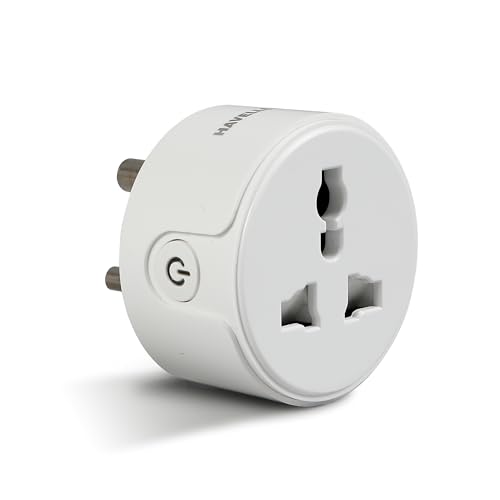
- Smart Control for Appliances: Power your appliances with this 10A Wi-Fi smart plug—ideal for 10A/6A appliances. Experien…
- No Hub, No Hassle: Avoid the hub and join wirelessly—this smart plug plugs into 2.4 GHz Wi-Fi network directly. Easy ins…
- Real-time Energy Monitoring: Keep tabs on your appliances’ current energy consumption using the DigiTap app. Conserve en…
7. AGARO Regency 16A Wi-Fi Smart Plug — Budget 16A Alternative Control
Best for: An Alexa-first & Google Assistant household controlling a high-load device with a physical on/off switch
Typical price: About ₹699 from Amazon.
Rated current: 16A
Maximum rated load: Not clearly specified by the manufacturer in the current Indian market
Connectivity: 2.4GHz Wi-Fi
App/ecosystem: Alexa & Google Assistant.
Energy monitoring: Yes.
Warranty: One-year Manufacturer warranty
WORKS WITH ALEXA & GOOGLE ASSISTANT: Control your home appliances hands-free with voice commands via Alexa and Google Assistant for seamless smart living.
16A HIGH CURRENT SUPPORT: Designed for heavy appliances like geysers, air conditioners, water heaters, microwave ovens and more without overload.
ENERGY MONITORING & APP CONTROL: Track energy usage in real-time and schedule on/off times using the dedicated smart app for smarter power management.
SCHEDULE & TIMER FUNCTION: Set timers and automated schedules to turn devices on/off at specific times — save energy and enhance convenience.
WIFI REMOTE ACCESS: Control connected devices from anywhere using your smartphone via Wi-Fi — no hub required.
Who should buy it: A budget-conscious buyer whose appliance, wall socket and circuit have been confirmed as compatible with the exact AGARO model and its documented load restrictions.
EasyFixGear verdict: An inexpensive 16A alternative with useful monitoring and voice-control features, but weaker manufacturer documentation means we would verify the exact model, load restrictions and appliance suitability carefully before choosing it over better-documented alternatives.

- WORKS WITH ALEXA & GOOGLE ASSISTANT: Control your home appliances hands-free with voice commands via Alexa and Google As…
- 16A HIGH CURRENT SUPPORT: Designed for heavy appliances like geysers, air conditioners, water heaters, microwave ovens a…
- ENERGY MONITORING & APP CONTROL: Track energy usage in real-time and schedule on/off times using the dedicated smart app…
What Is a Smart Plug and How Does It Work?
The power path is simple:
Wall socket → smart plug → appliance
The control path is usually:
Phone, automation or voice assistant → Wi-Fi/platform → smart plug
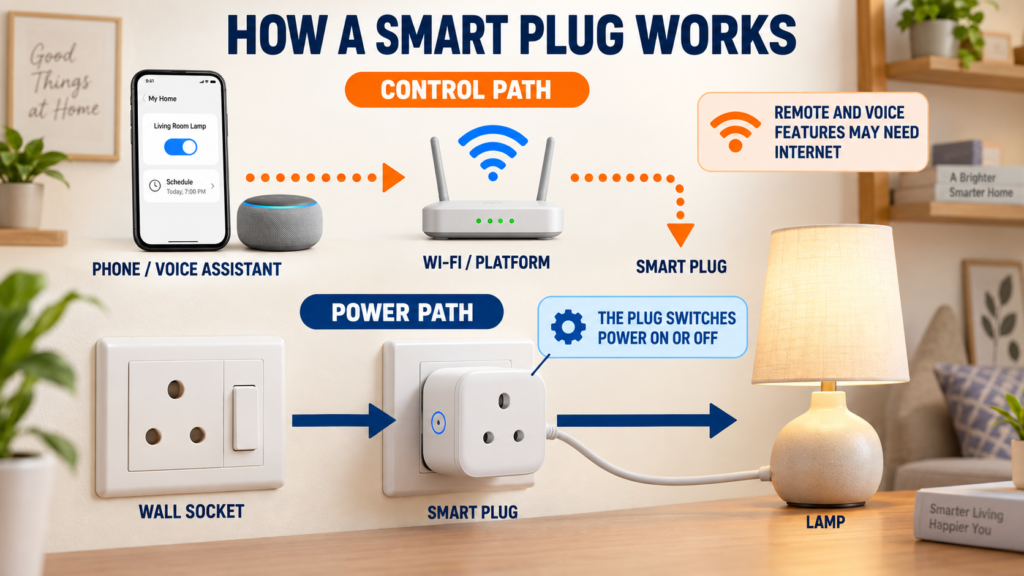
Inside the plug, an electronic relay switches power to the appliance. The appliance must be capable of resuming operation when power is supplied. A lamp with a mechanical switch usually works well. A touch-control appliance that remains off after power is restored may not.
The button on most plugs provides manual on/off control. Remote commands and voice control commonly depend on the manufacturer’s cloud service and internet access. Some models retain schedules locally or offer local network/Bluetooth control, but this varies. Qubo documents Bluetooth fallback and offline schedules; TP-Link documents local-LAN app control for P110.
10A vs 16A Smart Plugs: What’s the Difference?
The ampere rating is an upper electrical current limit under the conditions stated by the manufacturer. At a nominal 230V, simple multiplication gives about 2,300W for 10A and 3,680W for 16A. Those figures are not universal appliance allowances.
| Factor | 10A smart plug | 16A smart plug |
|---|---|---|
| Typical physical use | Common smaller Indian sockets/plugs, model dependent | Larger 16A Indian socket and appliance plug |
| Theoretical 230V calculation | About 2,300W | About 3,680W |
| Suitable examples | Only appliances allowed by the plug maker and within all limits | Only manufacturer-approved appliances within all limits |
| Key risk | Assuming 10A means every sub-2,300W appliance is suitable | Assuming 16A means every heavy appliance is suitable |
| What else matters | Continuous load, appliance type, plug fit, socket/circuit condition | All 10A factors plus startup/inrush and sustained heating load |
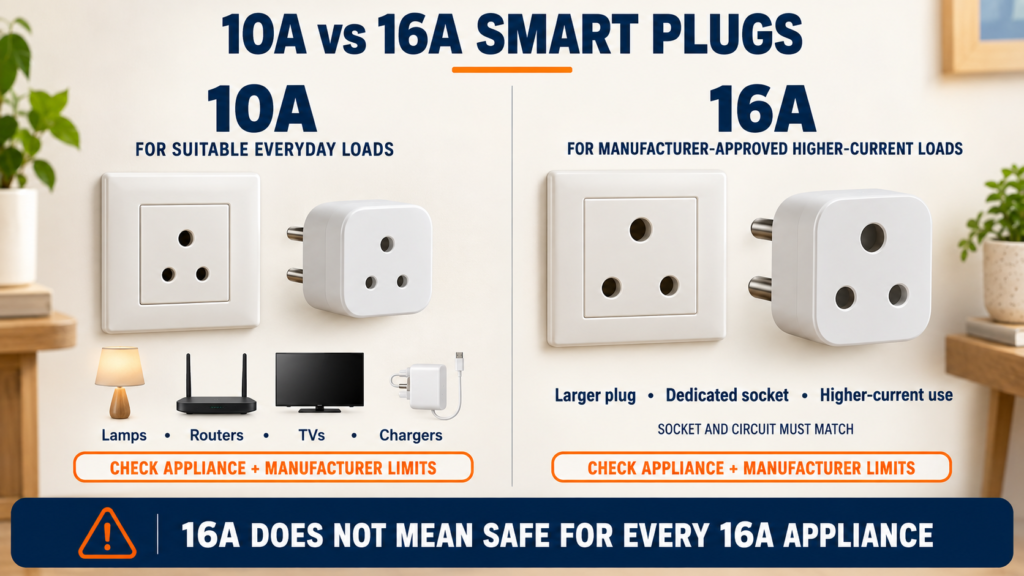
A resistive appliance converts electricity mainly into heat and may draw a sustained high current. Motors and compressors can briefly draw much more current when starting than their running label suggests. Electronics may also have inrush current. The smart plug’s relay, thermal design and maker-approved appliance categories therefore matter alongside arithmetic.
Never force a 16A plug into a smaller socket or use an adapter to “make it fit.” A smart plug does not upgrade the wall wiring, socket or circuit protection.
Which Appliances Can You Use with a Smart Plug?
Smart plugs make the most sense with appliances that:
- fall comfortably within the manufacturer’s limits;
- are explicitly allowed by the smart-plug maker;
- use a compatible plug and standard wall socket; and
- safely resume operation when electrical power is restored.
Common candidates include lamps, decorative lights, routers, chargers, televisions, air purifiers and some fans or small appliances. A router can be scheduled for a controlled restart, although a power cut will still stop both router and smart plug. A TV can have standby power measured, but repeatedly cutting power may interfere with updates or normal shutdown behaviour; consult the TV maker.
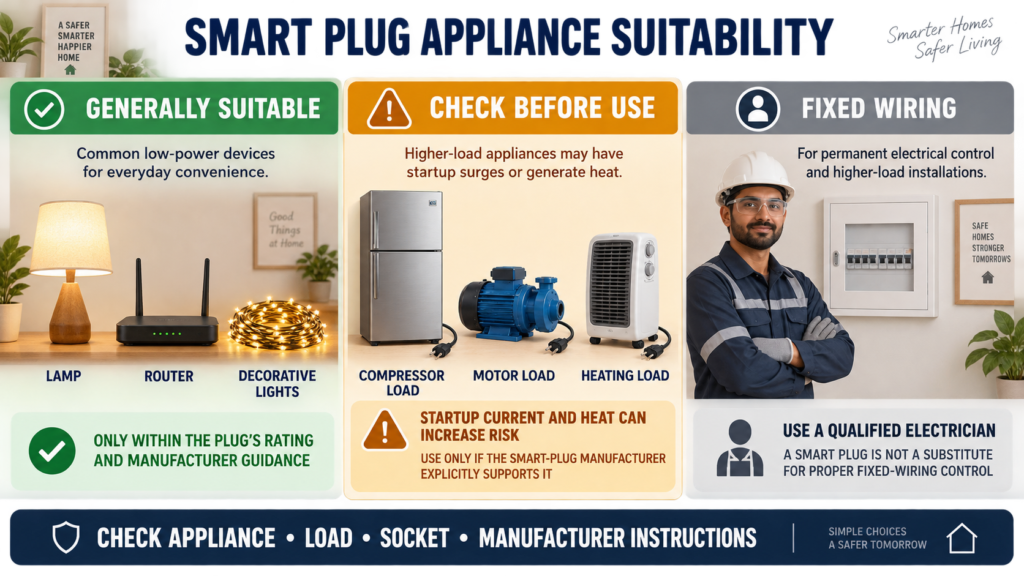
Use extra caution with air conditioners, refrigerators, pumps and other motor/compressor appliances because of startup current. Geysers, room heaters and induction cooktops impose demanding heating loads. Do not automatically connect any of these because a product says “16A.” Use them only when the smart-plug manufacturer explicitly supports the appliance and load, the appliance maker permits external power switching and the socket/circuit are appropriate.
For a high-load or fixed-wiring job, a qualified electrician may recommend purpose-designed controls rather than a plug-in adapter.
Smart Plug with Energy Monitoring: Is It Worth Paying More?
Usually, yes, when you have a question that data can answer. Real-time power can reveal whether a device is actively working or sitting in standby. Daily and monthly history can expose waste, compare routines and estimate cost after you enter your electricity tariff.
The feature is less valuable if you only want to switch one lamp on at sunset. It also does not make the smart plug a billing-grade or laboratory-grade meter unless the manufacturer documents that accuracy and certification. Treat the readings as household guidance, not evidence for a billing dispute or equipment diagnosis.
Alexa vs Google Home vs Matter Compatibility
Alexa and Google Home normally connect to the manufacturer’s cloud account. “Works with Alexa” may provide basic on/off and routines while detailed energy charts remain available only in the manufacturer app.
Matter is a cross-brand smart-home standard that can allow compatible devices to work with Apple Home, Alexa, Google Home and other Matter controllers. None of the exact Indian variants shortlisted here had verified Matter support in the manufacturer material we reviewed. Do not assume that a similarly named overseas Tapo, Kasa or WiZ model has the same plug shape, electrical rating or Matter capability as the Indian unit.
Qubo explicitly says its plugs do not support Apple HomeKit. Apple Home users should therefore look for an India-compatible plug whose exact model is certified for Matter or Apple Home, and verify the electrical specifications independently.
Do Smart Plugs Work Without the Internet?
The honest answer is: partly, and it depends on the model.
- A physical button normally continues to switch the relay while mains power is present.
- TP-Link says the P110 remains controllable in the Tapo app over the local LAN if the household internet connection is down.
- Qubo says its schedules continue offline and Bluetooth can provide local app control when Wi-Fi/internet is unavailable.
- Remote control from outside the home and cloud voice assistants normally need working internet.
- “No internet” is different from “no Wi-Fi.” A local feature may need the router even when the external internet is down.
Check the exact manual if offline operation is important; do not rely on a generic statement about smart plugs.
What Happens After a Power Cut?
The smart plug itself switches off when mains power fails. When power returns, it may stay off, turn on, restore its previous state or follow a configured recovery setting. Schedules may resume immediately or only after Wi-Fi, time synchronisation or cloud reconnection.
Amazon specifically documented state retention for its Indian 6A plug. Recovery behaviour was not clearly specified in the current online material for several other shortlisted models. Test the behaviour with a harmless low-load device before relying on automation, and never use automatic restart where an unattended restart could create danger.
Smart-Plug Privacy and Security
A smart plug is a small networked computer tied to an account. Use a unique password, enable two-factor authentication when offered, install firmware updates and keep the router protected with modern Wi-Fi security. Review app permissions and avoid granting contacts, location or background access unless a feature genuinely needs it.
Buy from a manufacturer that still provides updates and a support channel. If an app disappears, firmware is abandoned or the company ends cloud service, retire or isolate the device rather than leaving unsupported equipment on the main home network. For sensitive households, a separate IoT network can reduce exposure, but it does not replace updates and good account security.
Smart Plug Safety Checklist
- Read both the smart-plug and appliance instructions.
- Match the plug to the appliance’s rated load and type, including startup demand.
- Use the correct Indian wall socket; never force pins or defeat earth connections.
- Do not use a loose, cracked, burnt, sparking or unusually hot socket.
- Keep an indoor plug dry and ventilated; do not cover it.
- Do not place it behind furniture where heat or damage cannot be noticed.
- Avoid extension boards, travel adapters and multi-plug combinations unless the manufacturer explicitly permits the exact arrangement.
- Never daisy-chain smart plugs, power strips or adapters.
- Stop using a plug that smells burnt, buzzes abnormally, discolours or becomes unusually hot.
- Use a qualified electrician for socket faults, fixed wiring or purpose-built high-load control.
How to Choose the Best Smart Plug for Your Home
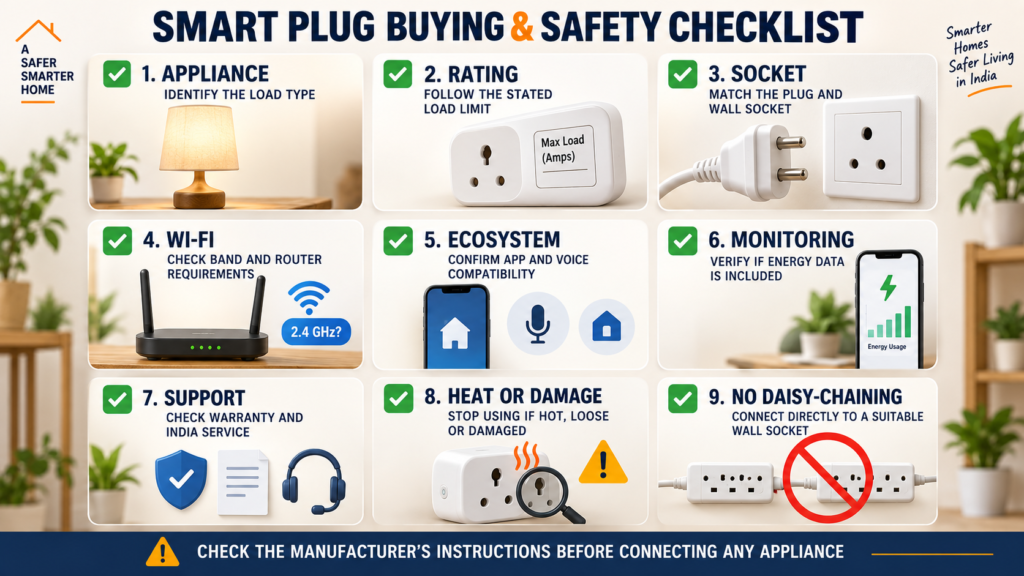
- Start with the appliance. Read its nameplate and manual. Note watts/amps, plug size, appliance type and whether it can safely restart after power returns.
- Verify electrical suitability. Check the smart plug’s current, voltage, maximum load and appliance restrictions. Leave a sensible margin; do not treat the label as a target.
- Inspect the socket. It must match physically, grip firmly and belong to an appropriate circuit.
- Choose the ecosystem. Alexa, Google Home, WiZ, Tapo and Qubo are not interchangeable. Pick the app you are willing to maintain.
- Decide whether monitoring matters. Buy it to answer a real usage or cost question, not just to collect graphs.
- Check connectivity. Most products require 2.4GHz Wi-Fi for setup and operation. Combined-band routers can occasionally need setup adjustments.
- Compare automations. Look for schedules, countdown, auto-off, scenes, Away Mode and documented offline behaviour.
- Assess the app and account. Consider family sharing, two-factor authentication, updates and permission requirements.
- Check support. Prefer a clear India warranty, authorised seller, return window and reachable support team.
- Compare total value. A ₹900 plug with the right documentation is better than a ₹600 unknown device connected to mains electricity.
If you are planning beyond one plug, see our guides to the best smart home devices in India and building a smart home on a budget in India.
Common Smart-Plug Buying Mistakes
- Choosing solely by amperage.
- Ignoring whether the appliance is resistive, motor-driven or compressor-driven.
- Assuming every 16A plug supports every air conditioner, geyser, heater or pump.
- Buying the wrong pin/socket format or relying on an adapter.
- Missing the 2.4GHz Wi-Fi requirement.
- Assuming energy monitoring is standard.
- Assuming Alexa compatibility includes every app feature.
- Expecting an overseas Matter model to match the Indian version.
- Buying an unsupported no-name device only because it is cheap.
- Failing to measure whether the body blocks an adjacent wall switch or socket.
- Ignoring warranty, seller authenticity and app longevity.
Are Smart Plugs Worth It?
Yes, when they solve a recurring problem: turning a lamp on at sunset, restarting a router on a controlled schedule, switching decorative lights off automatically or measuring how much a suitable appliance consumes. They can make rented homes smarter without replacing wall switches.
At the same time, they are not worthwhile when an ordinary switch is already convenient, the appliance has better built-in controls, a mechanical/digital timer meets the need, or the load is inappropriate. They also add standby consumption, another app/account and a cloud dependency. The safest smart plug is sometimes no smart plug at all.
Final Verdict
Choose in this order: appliance → electrical suitability → wall socket → ecosystem → useful features → budget.
For most buyers, Tapo P110 is the best-researched all-rounder because it combines detailed load specifications, energy monitoring, protective features and offline local-LAN control. Qubo 10A is the better-value choice for suitable ordinary appliances, while Qubo 16A is a cost-effective higher-current option only after confirming exact appliance support. Philips WiZ makes sense for an existing WiZ setup; Wipro is a credible India-focused alternative; Havells is a budget 10A candidate with thinner documentation; and AGARO is a lower-cost 16A alternative that warrants careful verification of the exact model and intended load.
Ultimately, the best smart plugs in India are the ones matched to a clearly defined job. Do not begin with “10A or 16A?” Begin with “What appliance am I controlling, what does its manufacturer allow, and is this plug explicitly suitable?”
Frequently Asked Questions
1. Which is the best smart plug in India?
Tapo P110 is the strongest overall research-based choice in this comparison because TP-Link clearly publishes its 16A/3,680W rating, energy functions, protection features and local-LAN control. Qubo 10A offers better value for many ordinary appliances. Suitability depends on the appliance, socket and ecosystem.
2. Is a 10A or 16A smart plug better?
Neither is universally better. A 10A model can be appropriate for a compatible ordinary appliance; a 16A model is needed for certain larger plugs and higher-current uses. The appliance type, startup current and manufacturer restrictions matter as much as the number.
3. Can I use a smart plug with an air conditioner?
Only when the exact smart-plug manufacturer explicitly supports that AC type and load, the AC manufacturer allows external switching, and the socket/circuit are suitable. Compressor startup current can exceed normal running current. Otherwise use the AC’s built-in smart controls or seek an electrician-designed solution.
4. Can I use a smart plug for a geyser?
Do not assume a 16A label makes it safe. A geyser is a sustained heating load. Use a plug only if the smart-plug maker expressly permits the appliance and rating, the geyser maker permits external switching and the socket/circuit are sound. Fixed-wiring work belongs to an electrician.
5. Do smart plugs work without Wi-Fi?
The physical button normally works while mains power is present. Other behaviour varies. Qubo documents Bluetooth fallback; Tapo P110 documents app control over the local LAN. Cloud remote control and voice assistants normally need internet access.
6. Do smart plugs work after a power cut?
They power up when electricity returns, but the resulting on/off state varies by model or setting. Amazon documents state retention for its Indian plug. Test recovery safely and never rely on an unattended restart for a hazardous appliance.
7. Do smart plugs consume electricity when switched off?
Yes. Their radio and control electronics require a small standby supply so they can receive commands. The exact standby consumption was not clearly stated for most models reviewed here.
8. Can smart plugs monitor electricity consumption?
Some can. The Tapo P110, Qubo 10A and 16A, Philips WiZ, Wipro, Havells and AGARO models reviewed here advertise energy-monitoring functionality. Consumer readings are useful for household guidance but should not be treated as billing-grade measurements unless the manufacturer documents suitable accuracy or certification.
9. Are smart plugs safe?
They can be safe when genuine, correctly rated, properly used and connected to a sound compatible socket. Risk rises with overloads, poor contacts, heat, moisture, adapters, daisy-chaining and unsuitable high-demand appliances. Stop using any plug or socket showing heat damage or abnormal behaviour.
10. Do I need Alexa or Google Home to use a smart plug?
Usually not. Most models work through their own app and manual button. A voice assistant is optional, although Amazon’s plug is designed around the Alexa app and does not support Google Home.
Last updated: 22 September 2026