Your vacuum starts leaving dust behind. You open the filter compartment, find a dusty filter and wonder whether a quick rinse under the tap will restore performance. If you are searching for how to clean a vacuum cleaner filter, start by identifying the exact filter and checking its manufacturer’s instructions. Some filters can be washed, some permit specific dry-cleaning methods, and others require replacement.
The safest approach answers three separate questions: What filter is this? What maintenance is allowed? When should it be replaced?
How to Clean a Vacuum Cleaner Filter: Quick Answer
- Switch off the vacuum and unplug it, or isolate/remove its battery as the manufacturer instructs.
- Identify the exact vacuum model and filter.
- Check the official manual or filter-care documentation.
- Follow the approved cleaning method, if one is provided.
- For a washable filter, follow the specified drying period and conditions, and wait until it is completely dry.
- Inspect and reinstall it correctly.
- Replace filters that are non-cleanable, damaged or due for replacement.
Safety warning
Do not wash a vacuum filter unless the manufacturer explicitly identifies that specific filter as washable.
Foam, pleats, “HEPA” and “reusable” labels do not establish washability. Tapping, brushing, compressed air and cleaning with another vacuum also require approval for the specific filter.
Identify Your Vacuum Filter Before Cleaning It
Filter descriptions refer to different things: location, material, shape or filtration performance. They can overlap.
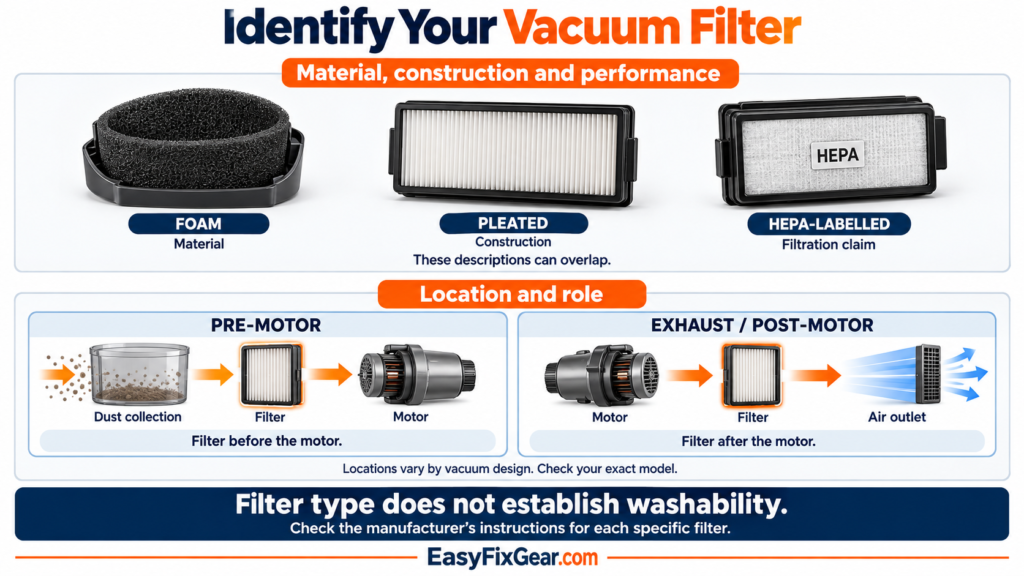
A vacuum pre-motor filter sits upstream of the motor and helps protect downstream components from dust. A vacuum exhaust filter treats air leaving the machine. Foam describes material; pleated describes construction; HEPA describes a filtration-performance designation.
A HEPA filter may be positioned before or after the motor, depending on the design. One vacuum may contain several filters with different care requirements.
| Filter description | Typical role | Can it be washed? | What to verify |
|---|---|---|---|
| Pre-motor | Helps protect the motor and downstream components | Manufacturer-specific | Location, removable parts and approved method |
| Post-motor/exhaust | Filters outgoing air | Manufacturer-specific | Cleaning permission or replacement requirement |
| Foam | Often used in a pre-filter or motor-protection stage | Manufacturer-specific | Whether washing, squeezing, or any other handling is permitted |
| Pleated | Provides a folded filtering surface | Manufacturer-specific | Media-care instructions and frame/seal condition |
| HEPA or HEPA-type | Describes a claimed filtration level | Manufacturer-specific | Standard or performance claim, washability and service life |
| Cartridge | Filter assembly fitted over or into a support | Manufacturer-specific | Exact cartridge number and locking arrangement |
| Wet-and-dry filter | Used in an approved liquid/debris collection system | Manufacturer-specific | Wet/dry configuration, bag requirements and drying instructions |
Photograph the fitted position before removal if helpful. Do not dismantle a bonded filter assembly simply because it appears to contain separate layers.
Can You Wash a HEPA Vacuum Filter?
Only when the manufacturer permits washing that exact filter. HEPA is not a cleaning instruction.
HEPA stands for high-efficiency particulate air. The US EPA describes HEPA filters as theoretically removing at least 99.97% of airborne particles measuring 0.3 micrometres. That is a filtration description, not permission to expose a filter to water. EPA: What is a HEPA filter?
Other classifications use different test criteria. Under EN 1822, for example, H13 has a minimum overall efficiency of 99.95% at the most penetrating particle size—the particle size that most readily passes through the tested filter. These figures should not be treated as identical tests.
“HEPA-type” or “HEPA-like” wording alone does not establish compliance with a named HEPA standard. Equally, do not assume every HEPA-labelled product has undergone the same independent verification. Look for documented performance and test information.
Washable HEPA filters do exist. Bosch explicitly identifies replacement filter 17007968, accessory reference BBZ153HF/VZ153HFB, as washable. Its compatibility must still be checked against the appliance; that listing does not authorise washing other Bosch filters. Bosch filter documentation
For vacuum HEPA filter cleaning, preserving the media, frame and seals matters. A tear can create a passage through the media; a damaged or poorly seated seal can allow air around it. Washing, scrubbing or aggressive handling may damage assemblies not designed for those methods.
A filter can also look clean while retaining embedded dust or reaching its specified replacement date. Visual inspection cannot confirm filtration efficiency. Follow the service schedule even when the surface appears acceptable.
How to Check Whether Your Vacuum Filter Is Washable
Use this sequence before choosing any cleaning method:
- Find the exact model number. Check the rating label, purchase documents or the manufacturer’s app. Include suffixes and regional variants.
- Identify the filter. Record its part/accessory number where available and whether it is the motor, exhaust or another filter.
- Open the official manual. Search the manufacturer’s support site using the complete model number.
- Locate filter-maintenance instructions. Check diagrams so you know which instructions apply to which component.
- Record the permitted method, frequency, drying requirements and replacement guidance.
- Contact manufacturer support if anything is missing or ambiguous. Send the model number, filter number and a photograph.
An instruction to wash the dustbin does not necessarily include the filter. An instruction to wash a foam insert does not necessarily include its surrounding assembly.
For third-party replacements, verify both compatibility and care instructions with the supplier/manufacturer. Similar appearance does not prove that the replacement uses the original filter’s materials or tolerates the same maintenance.
Washable vs Non-Washable Vacuum Filters
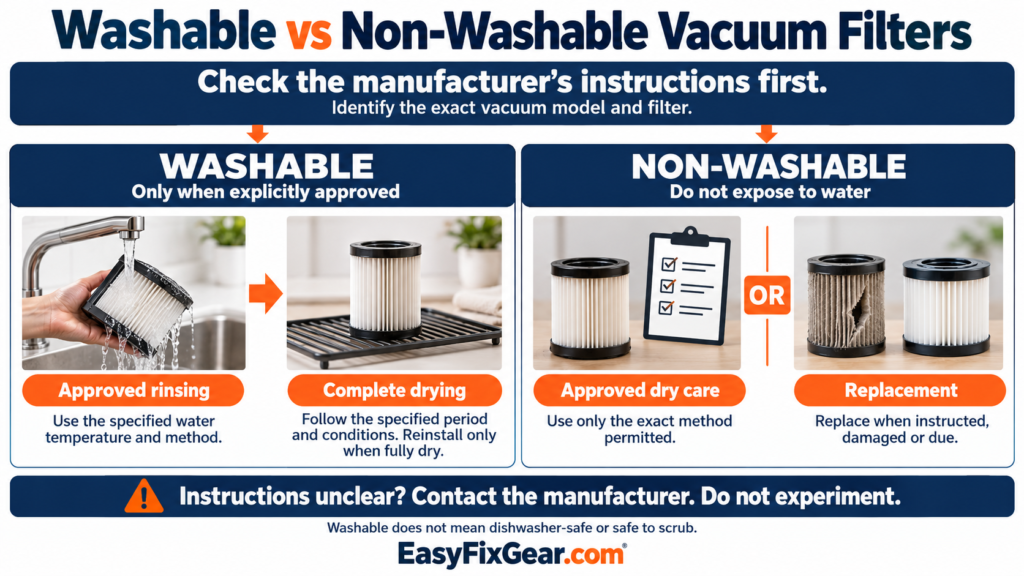
| Question | Washable filter | Non-washable filter |
|---|---|---|
| How is status established? | Explicit manufacturer permission for the exact filter | Manufacturer prohibits washing or specifies another care route |
| Permitted maintenance | Only the documented washing/handling procedure | Approved dry care, or replacement |
| Water exposure | Specified temperature and technique | Keep out of water |
| Drying | Specified conditions/time, plus complete dryness | Not applicable unless accidentally wetted; seek guidance |
| Main damage risks | Unapproved chemicals, scrubbing, heat or handling | Water exposure and unapproved dry-cleaning methods |
| Replacement | Damage, end of service life or unresolved restriction | Specified schedule, damage or condition-based need |
| Manual unavailable | Verify before washing | Verify before attempting any cleaning |
Washable does not mean dishwasher-safe, machine-washable or safe to scrub. Each additional method needs explicit permission.
How to Clean a Washable Vacuum Filter Safely
Use these steps only after the manufacturer confirms washability. The exact manual determines the details.
- Disconnect power. Switch off and unplug, or follow the battery-isolation procedure. Allow hot components to cool where necessary.
- Remove the filter as instructed. Release the correct latch or locking ring without forcing it.
- Remove loose debris only by approved methods. Do not automatically tap or brush the media.
- Rinse using the specified water temperature and technique. Follow instructions about which surfaces to rinse.
- Avoid unapproved products and tools. Do not add detergent, bleach, solvents, disinfectant, essential oils or fragrance.
- Drain as directed. Squeezing, twisting or shaking is appropriate only where permitted.
- Allow complete drying. Meet both the manufacturer’s time/conditions and the fully-dry requirement.
- Inspect the assembly. Look for tears, cracks, deformation and damaged seals.
- Reinstall correctly. Match the orientation, seat seals and close covers securely.
- Test according to the manual. Keep required filters installed and stop if abnormal symptoms occur.
For a specific example, the Dyson V8 SV10 Absolute manual identifies two washable filters and gives separate procedures for them. It specifies cold water, prohibits detergent and requires complete drying for a minimum of 24 hours. Those instructions belong to the documented model and filter assemblies. Dyson V8 SV10 manual
Never wash the motor, battery or electrical assembly along with a removable filter.
How to Maintain a Non-Washable Vacuum Filter
Non-washable does not necessarily mean non-cleanable. It also does not mean every dry-cleaning method is safe.
For the Roomba Combo i5+, iRobot permits removing debris by tapping the filter against a rubbish container, but explicitly prohibits washing it. Follow that model’s removal and refitting instructions rather than transferring the method to another robot. Roomba Combo i5+ manual, filter-care section
If the manufacturer specifies replacement without cleaning, replace it. Do not improvise with compressed air, a brush or another vacuum.
Water may affect media, adhesives or structural components in filters not designed for washing. Drying an accidentally washed filter does not prove that its performance has been restored. Contact support about replacement before reuse.
How to Clean Foam and Pre-Motor Filters
Vacuum foam filter cleaning begins with documentation, even when the material resembles an ordinary sponge.
Philips’ filter-care guidance distinguishes washable motor-protection components from non-washable exhaust filters. Its bagged and bagless procedures also describe different component handling. Check that the guidance applies to your exact appliance. Philips India filter-care instructions
A specific Philips example, FC9352/62, lists a washable motor filter and an Allergy H13 exhaust filter. This specification establishes different filtration stages; it should not be transferred automatically to another FC9352 suffix. Philips FC9352/62 specification
By comparison, Kärcher’s cited WD/KWD manual permits rinsing the covered foam/cartridge filters but prohibits rubbing or scrubbing them. Kärcher WD/KWD manual
Reassemble every required layer and holder. A misplaced insert or missing seal can interfere with the intended dust barrier.
Do Exhaust Filters Need Cleaning or Replacement?
Exhaust filters need the care specified for their own assembly. Do not assume they share the pre-motor filter’s instructions.
Philips’ cited support guidance says its covered exhaust filters should not be washed or cleaned and recommends annual replacement. This is guidance for the appliances covered by that documentation, not a universal exhaust-filter schedule. Philips exhaust-filter guidance
Other exhaust assemblies may permit washing. Verify the exact part before deciding.
How Long Should a Washed Vacuum Filter Dry?
There is no universal answer to how long to dry a vacuum filter. Material, thickness, trapped water, airflow, room temperature and ambient humidity affect drying.
The Dyson V8 SV10 manual requires a minimum of 24 hours and complete dryness. Kärcher’s cited WD/KWD manual requires complete drying before reuse without giving one fixed hourly duration. Dyson V8 manual, Kärcher filter-care instructions
Treat a stated minimum as a minimum, not a guarantee. A surface may feel dry while thicker material or recessed areas retain moisture.
During humid monsoon weather, drying may take longer. Continue drying under the permitted conditions; do not substitute a guessed duration for complete dryness. If uncertain, leave it out and seek guidance.
Do not use a hair dryer, oven, heater, direct high heat or another forced-drying method unless expressly permitted. Do not run the vacuum to “finish drying” its filter.
What Happens If You Put a Damp Filter Back in a Vacuum?
A wet vacuum filter can create several problems:
- Moisture and dust can form deposits that restrict airflow.
- Dust may stick to damp media.
- Damp collected material may develop unpleasant odours.
- Persistent moisture can support microbial growth under suitable conditions.
- In designs where moisture can reach downstream components, damage or malfunction is possible.
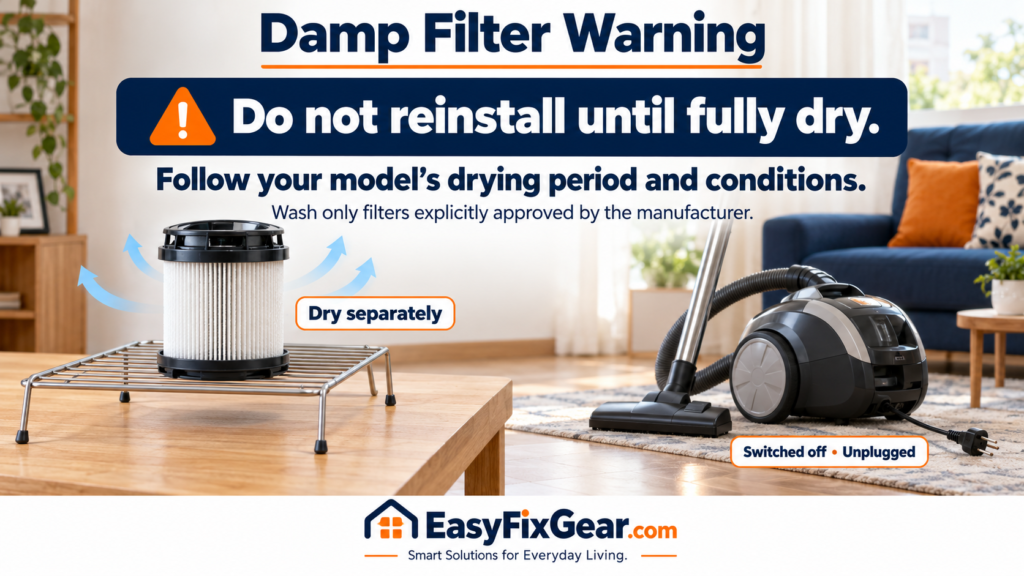
Dyson’s troubleshooting documentation identifies a wet reinstalled filter as a possible cause of a damp or musty smell. EPA guidance establishes moisture as a requirement for mould growth; it does not prove that every damp filter will develop mould. Dyson odour troubleshooting, EPA moisture guidance
A damp filter will not necessarily destroy the motor immediately, but it should never be reinstalled in a dry-use vacuum.
Already used it damp? Stop, disconnect power and follow the manual. Remove it for approved drying or replacement. If moisture reached electrical components, or you notice burning smells, sparking, abnormal heat or repeated shutdown, seek authorised service before further use.
If your vacuum filter smells after washing, check for complete dryness and permitted maintenance of the bin and air path. Do not mask the smell with fragrance products.
How Often Should You Replace a Vacuum Filter?
Vacuum filter replacement depends on the manufacturer, model, filter, usage and condition.
Fine dust, pets and frequent use may increase maintenance needs. Persistent restriction, odour, visible damage and maintenance history also matter, but none creates one universal replacement interval.
| Situation | What to check | Clean or replace? |
|---|---|---|
| Dust-loaded, intact filter | Approved method and schedule | Clean only if permitted |
| Torn/punctured media | Visible damage | Replace |
| Damaged frame or seal | Fit and integrity | Replace affected assembly |
| Persistent clogging | Correct maintenance and other airflow restrictions | Replace or seek support if unresolved |
| Non-washable filter | Dry-care permission and replacement schedule | Approved dry care or replacement |
| Persistent odour | Moisture, collected debris and manufacturer advice | Replace or seek support when unresolved |
| Missing documentation | Exact part and support confirmation | Verify before maintenance |
| Scheduled replacement due | Model-specific interval | Replace as directed |
Washing does not reset a filter’s service life indefinitely.
Vacuum Filter Care in Indian Homes
Fine household dust and dust entering from nearby construction can load filters quickly. Inspect according to the manual and use permitted maintenance when needed.
Pet hair and long hair also collect around rollers, inlets and bin openings. Cleaning the filter alone will not clear these restrictions. Balcony debris may contain grit or damp material: check suitability before pickup.
Do not use an ordinary household vacuum for asbestos, hazardous construction dust or unknown toxic materials. A HEPA label alone does not establish suitability for hazardous cleanup. EPA guidance also distinguishes a HEPA filter from an appropriately designed, sealed HEPA vacuum system. EPA guidance on HEPA vacuums
During the monsoon, plan permitted washing when you can leave the filter out until fully dry.
Do Bagged and Bagless Vacuums Need Different Filter Care?
A bagged vacuum collects debris in a bag, while a bagless model uses a container and its separation system. Both can have additional motor and exhaust filters.
Inspect the bag/bin, inlet and filters as instructed. Fine dust can restrict a bag before it looks completely full; bagless filters can also become loaded despite regular bin emptying.
Bagged does not mean maintenance-free, and bagless does not mean washable. Each filter requires its own documented care.
Cleaning Filters in Cordless Stick Vacuums
Compact cordless designs make correct removal and reassembly especially important.
Switch off, disconnect charging and follow the manufacturer’s battery-isolation instructions. Remove a user-removable battery where instructed; do not dismantle a sealed pack.
Identify each filter, follow approved washing/drying and check the locking position when refitting. The Dyson V8 SV10 example illustrates why separate filter procedures matter. Owners should locate their exact variant through Dyson India’s manuals directory.
A filter warning or pulsing behaviour still requires model-specific troubleshooting.
Can You Wash a Robot Vacuum Filter?
Only if the exact robot/filter instructions allow it.
A washable dustbin or mop pad does not establish filter washability. For the Roomba Combo i5+, the manual permits bin washing after filter removal, prohibits washing the filter and specifies filter replacement every two months, with replacement frequency qualified by condition. iRobot Combo i5+ manual
Check robot shutdown instructions and avoid accidental scheduled operation during maintenance. Keep the robot, dock and electrical contacts out of water.
For differences in cleaning roles, see Robot Vacuum vs Regular Vacuum.
Filter Care for Wet-and-Dry Vacuums
Wet-and-dry vacuums require their exact wet-pickup and dry-pickup configuration.
The cited Kärcher WD 2 Plus/WD 3/KWD family manual requires the fitted foam or cartridge filter for both modes, prohibits using a filter bag for wet pickup and requires completely dry filters for dry vacuuming. It also permits rinsing covered filters without rubbing or scrubbing. These rules apply to the listed variants and fitted filter, not every wet-and-dry vacuum. Kärcher operating manual
Other designs may use different foam, cartridge or bag arrangements. Never assume liquid pickup means removing all filtration.
See Wet & Dry Vacuum Cleaner: Is It Worth Buying? for appliance suitability.
Vacuum Losing Suction After Cleaning the Filter?
Disconnect power before inspecting. Use any powered test only as the manual permits, with required filters installed.
| Possible cause | What to check | Safe next step |
|---|---|---|
| Filter still damp | Drying conditions, minimum period and residual moisture | Stop use; dry fully or replace as appropriate |
| Incorrect installation | Orientation and locking position | Refit according to diagrams |
| Cover not closed | Latches and obstruction | Seat and close correctly |
| Misaligned gasket/seal | Pinching, displacement or damage | Reposition or replace as directed |
| Damaged filter | Tears, cracks or deformation | Replace |
| Hose/wand blockage | Accessible air path | Clear using approved procedure |
| Full bin/bag | Fill level and inlet | Empty or replace as directed |
| Incompatible replacement | Exact model/part compatibility | Fit the correct approved filter |
| Floor-head problem | Tangled brush, blocked inlet or wrong setting | Follow head-maintenance instructions |
Dirty vacuum filter symptoms—weak pickup, warnings or shutdown—can overlap with other faults. They do not prove the filter is responsible.
For the complete diagnostic sequence, read Why Is My Vacuum Cleaner Losing Suction?. To understand airflow and performance terminology, see Vacuum Cleaner Suction Power Explained.
Signs You Should Replace Rather Than Clean a Filter
Replace an affected filter assembly when it has torn or punctured media, a cracked frame, damaged seals or deformation that prevents correct fitting.
Persistent restriction after approved maintenance warrants checking the complete air path and consulting support. Replace when the manufacturer specifies end of service life.
Do not repair filter media with tape, glue or improvised patches. These cannot establish restored airflow or filtration performance.
Vacuum Filter Cleaning Mistakes to Avoid
- Washing an unidentified filter or assuming every HEPA filter is washable.
- Washing a non-washable filter.
- Using unapproved detergent, disinfectant or fragrance.
- Scrubbing delicate media or improvising with compressed air.
- Drying with unapproved heat.
- Reinstalling while damp.
- Operating without required filters.
- Confusing washable-bin instructions with filter instructions.
- Buying an incompatible replacement.
- Ignoring damaged seals.
- Neglecting the bin, hose, wand or floor head.
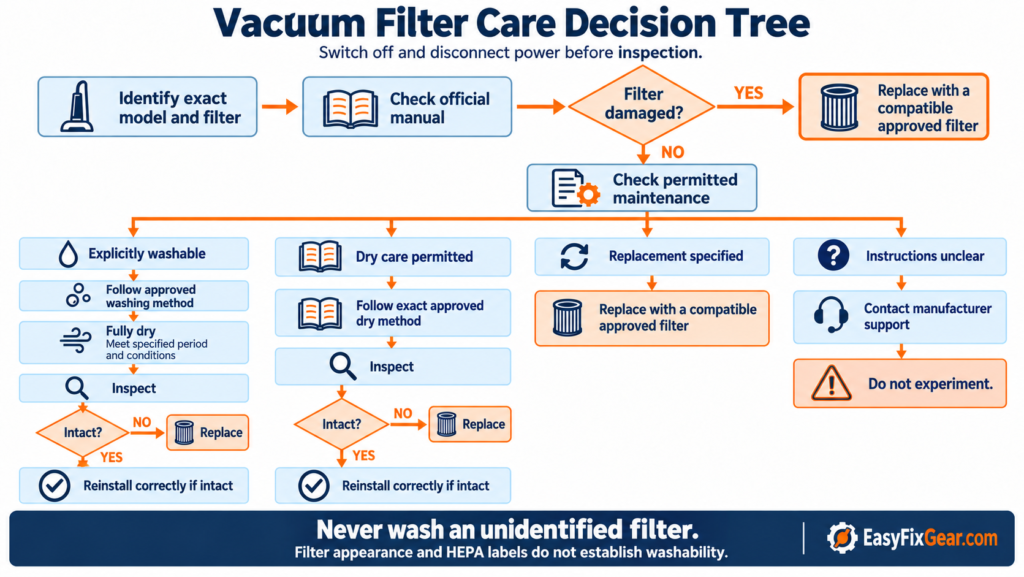
Should You Wash, Dry-Clean or Replace Your Vacuum Filter?
Use this decision tree for each filter separately:
Exact model and filter identified?
- No → Find the manual or contact support.
- Yes → Inspect for damage.
- Damaged → Replace with a compatible approved assembly.
- Intact → Check manufacturer instructions.
- Explicitly washable → Follow approved washing → meet drying requirements → confirm complete dryness → inspect → reinstall.
- Approved dry cleaning → Follow that exact method → inspect → reinstall.
- Replacement specified → Replace as directed.
- Instructions unclear → Contact support; do not experiment.
Where cleaning and scheduled replacement both apply, cleaning does not cancel replacement guidance.
Vacuum Filter Maintenance Checklist
- Exact model and filter identified.
- Official care instructions located.
- Approved method and replacement guidance recorded.
- Power disconnected; hot components cooled.
- Filter removed using the specified procedure.
- Media, frame and seals inspected.
- Only approved maintenance completed.
- Washed filter completely dry; specified conditions/time satisfied.
- Final damage check completed.
- Filter, holders, seals and covers correctly reassembled.
- Manual-approved test completed.
- Next inspection/replacement reminder recorded.
How to Clean a Vacuum Cleaner Filter Without Damaging It
EasyFixGear’s practical recommendation is simple: correct filter care begins with the manual, not the sink.
For anyone asking how to clean vacuum cleaner filter components safely, follow:
Identify → Verify → Clean if permitted → Dry fully → Inspect → Reinstall → Replace when necessary.
A washable filter needs the exact approved washing and drying procedure. A non-washable filter needs only permitted dry care or replacement. If performance remains poor, inspect the complete airflow path instead of repeatedly washing the filter.
Frequently Asked Questions
How do I clean a vacuum cleaner filter?
Identify the exact model and filter, disconnect power and follow its official maintenance instructions. Clean only if permitted, dry washable filters completely and reinstall correctly.
Can I wash a HEPA vacuum filter?
Only when its manufacturer explicitly permits washing that specific filter. HEPA describes filtration performance, not washability.
How do I know whether my vacuum filter is washable?
Check the exact model’s official manual and filter documentation. Contact manufacturer support if the instructions are missing or unclear.
Can I clean a non-washable vacuum filter?
Sometimes. Use only a dry-cleaning method approved for that filter. If replacement is specified, replace it.
How long should a vacuum filter dry?
Follow its manufacturer’s specified period and conditions, and wait until completely dry. A minimum time is not a guarantee of dryness.
What happens if I use a damp vacuum filter?
Possible consequences include restricted airflow, odour and moisture-related malfunction or damage. Stop use, disconnect power and follow drying, replacement or service guidance.
Can I use soap to wash a vacuum filter?
Only if the manufacturer expressly permits it. Otherwise, use the specified water-only procedure for a confirmed washable filter.
How often should I replace a vacuum filter?
Follow the exact model/filter schedule and condition guidance. Damage, persistent restriction or unresolved odour may require earlier replacement or support.
Can I use my vacuum without a filter?
Do not operate without required filters unless the manufacturer expressly permits a specific maintenance test.
Why is my vacuum losing suction after cleaning the filter?
Check for complete dryness, correct installation, covers, seals and compatibility. Then inspect the bin/bag, hose, wand and floor head.
How We Researched
This guide draws on official Philips, Dyson, Bosch, iRobot and Kärcher documentation, plus EPA and Camfil filtration/moisture references. Examples apply only to the named filters or documented models. EasyFixGear did not conduct hands-on appliance tests or laboratory filtration measurements.
Research Sources
- Filter identification and care: Philips India filter instructions, FC9352/62 specification.
- Cordless washing and drying: Dyson V8 SV10 Absolute manual.
- Washable HEPA example: Bosch 17007968 filter documentation.
- Robot care: Roomba Combo i5+ manual.
- Wet-and-dry configuration: Kärcher WD/KWD manual.
- Technical references: EPA HEPA definition, Camfil EN 1822 table, EPA moisture guidance.
Last updated: 1 October 2026