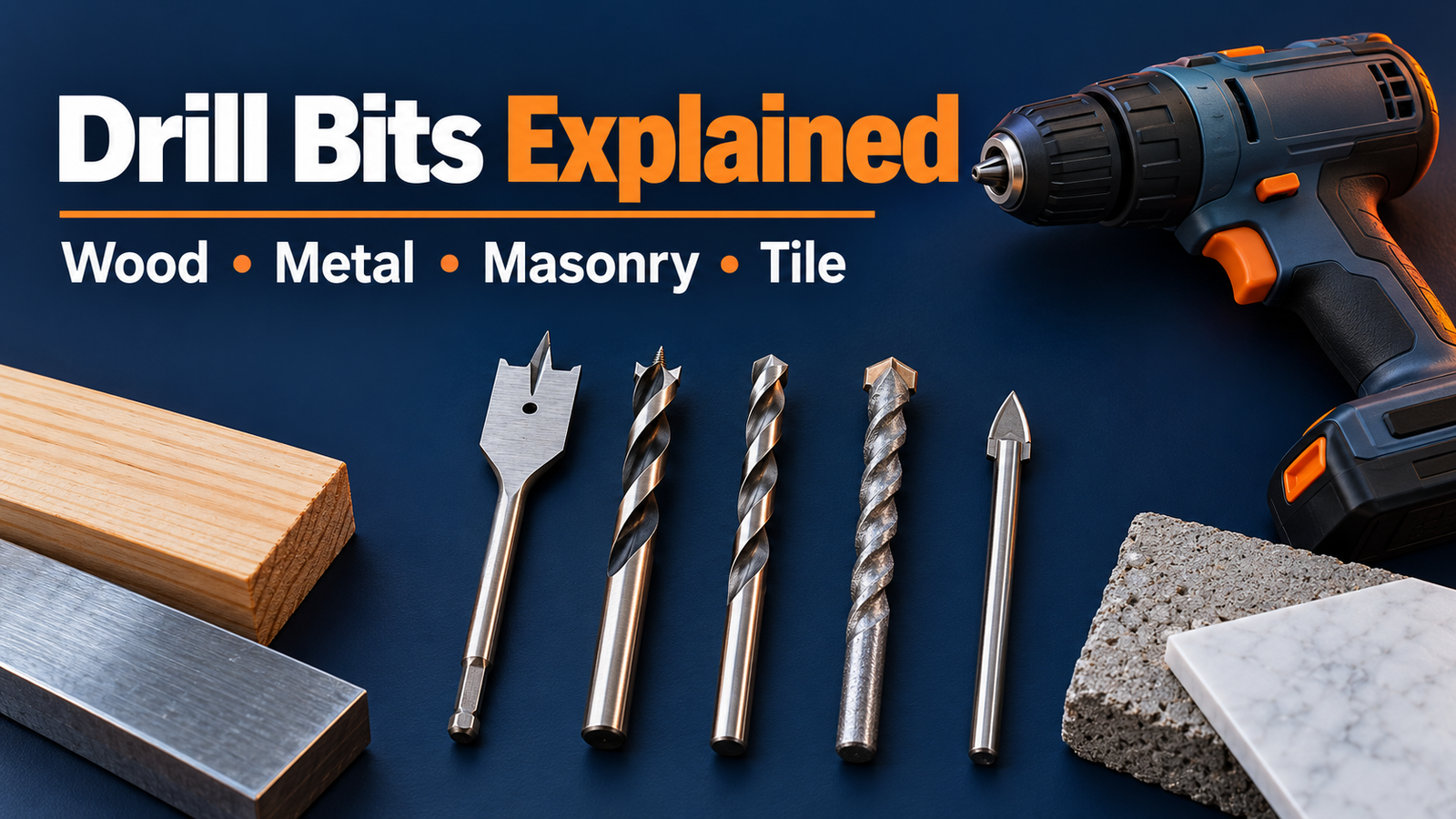
The right drill bit starts with the material you want to drill. A bit that makes a clean hole in plywood may struggle against brick, while a concrete bit can damage a metal bracket or crack a bathroom tile. Choosing among the different types of drill bits becomes easier when you follow this sequence:
Material → bit type → hole size → shank/chuck compatibility → tool and mode → safety.
This guide explains the major bit families, how to recognise them, and how to choose an appropriate combination for common Indian home DIY jobs.
Quick Answer
Brad-point bits commonly suit accurate wood drilling; suitable HSS twist bits handle many ordinary metal jobs; carbide-tipped masonry or concrete bits suit their specified mineral materials; and tile needs a tile-specific or diamond solution matched to its hardness. Check the required hole diameter, bit shank, drill capacity and drilling mode before starting. SDS is a tool connection system, not a bit material.
Key Takeaways
- Match the cutting end to the material and the shank to the tool.
- Drill-bit diameter, working length and shank size are separate specifications.
- Follow the fixing manufacturer’s hole requirements for wall plugs and anchors.
- A high torque rating does not make an ordinary cordless drill suitable for demanding concrete drilling.
- Tile, glass and structural materials require particular care.
How We Researched
This guide draws on manufacturer accessory specifications and guidance from Bosch Professional, IRWIN, DEWALT, Hilti, fischer and SPAX, alongside Pilkington glass guidance and CCOHS drilling-safety information. Recommendations describe common applications and their limitations. This is a researched reference guide; we have not physically tested the accessories discussed.
Understand the Material Before Choosing a Bit
Identify what lies at the drilling point, including any layers behind the visible surface.
A painted wall could conceal brick, concrete, hollow block or another construction. A bathroom tile may cover masonry or a board system. Furniture described as “wooden” may contain solid timber, plywood, MDF or particleboard.
Also establish what the hole must do:
- Guide a screw.
- Allow a bolt or cable to pass through.
- Receive a wall plug or anchor.
- Form a recess.
- Create a larger opening for a fitting.
These requirements determine the bit’s geometry, diameter and useful depth.
For a beginner’s toolkit, a few suitable bits, clamps and protective equipment are more useful than a large assortment you cannot identify. Our guide to essential tools for homeowners puts drilling equipment into that wider context.
Drill Bit Anatomy: What Each Part Does
A conventional twist bit provides a useful starting point, although other designs may have different features.
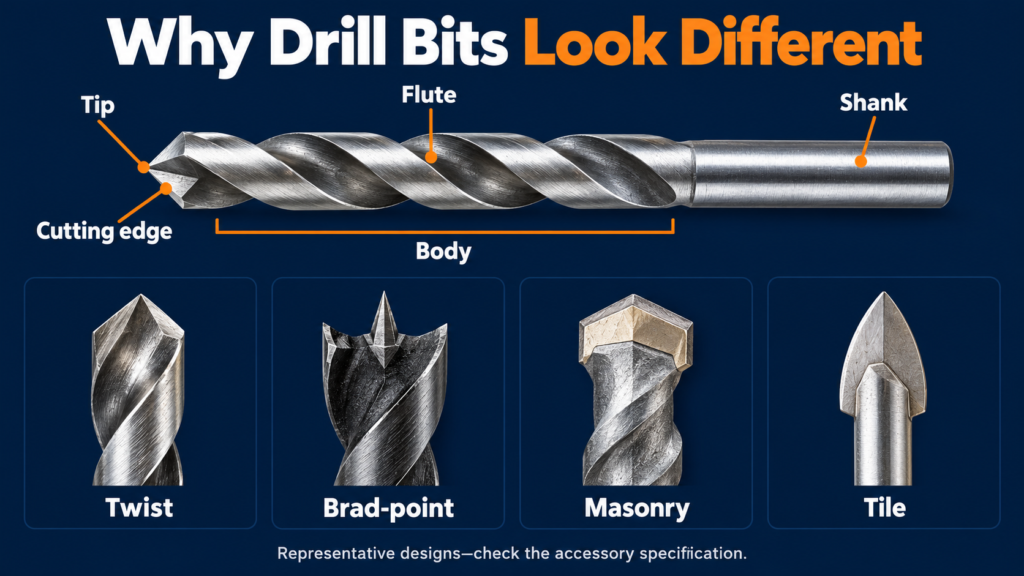
| Part | What it does | Why it matters |
|---|---|---|
| Tip | Starts the hole and helps establish position | Different materials need different starting and cutting geometry |
| Cutting edge | Removes material | Its shape and condition affect cutting performance |
| Flute | Provides space for chips or drilling dust to leave the hole | Blocked flutes can interfere with cutting |
| Body | Supports the working portion of the bit | Its dimensions and construction affect reach and stability |
| Shank | Connects the accessory to the tool | It must match the chuck or holder |
A pointed centre spur often identifies a wood brad-point bit. A masonry bit commonly has a carbide cutting head. Some tile bits have a spear-like tip; diamond hole cutters have an abrasive rim.
Use these features as clues, then confirm the packaging or manufacturer’s specification. Shape and colour alone cannot prove suitability.
Not every bit has spiral flutes. Some tile bits are flute-less, and hole saws cut around the outside of a circular opening.
Main Types of Drill Bits and Their Uses
The following categories overlap. “Twist” describes a shape, “HSS” describes a material, and “SDS” describes an interface. A single accessory can therefore belong to more than one category.
1. Twist Drill Bits
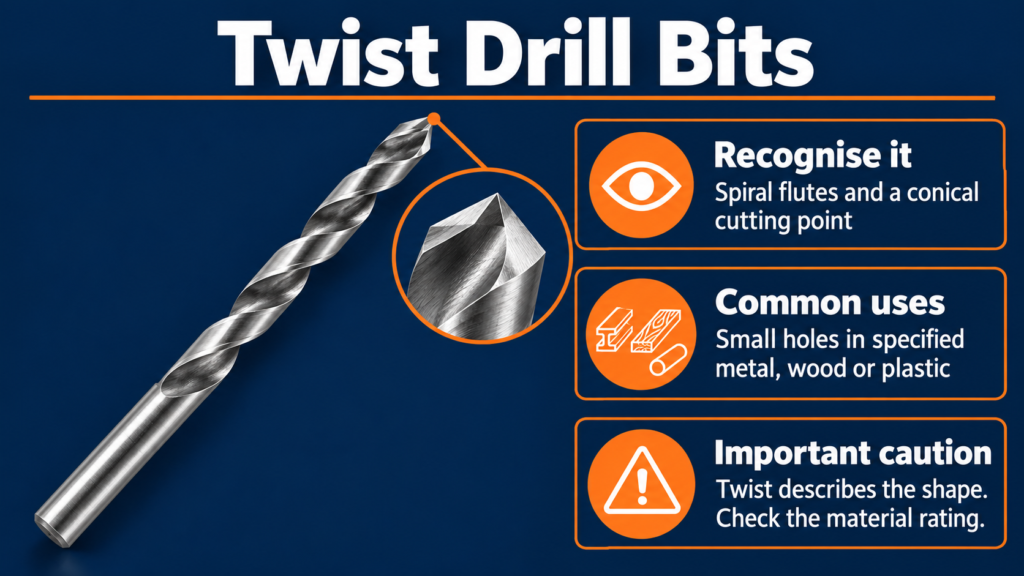
Twist bits have a pointed cutting end and spiral flutes along the body. They are among the most familiar drilling accessories.
Suitable versions can drill metal, wood or plastic, but the intended material depends on the bit’s construction and geometry. Do not assume that every spiral-shaped bit is interchangeable.
For ordinary metal work, look for a twist bit explicitly specified for the metal involved. For accurate woodworking, a brad-point design may offer a more controlled start.
IRWIN, for example, specifies particular HSS hex-shank bits for wood, metal and plastic; that suitability applies to those accessories rather than every twist bit. IRWIN HSS bit specification
2. Brad-Point Drill Bits
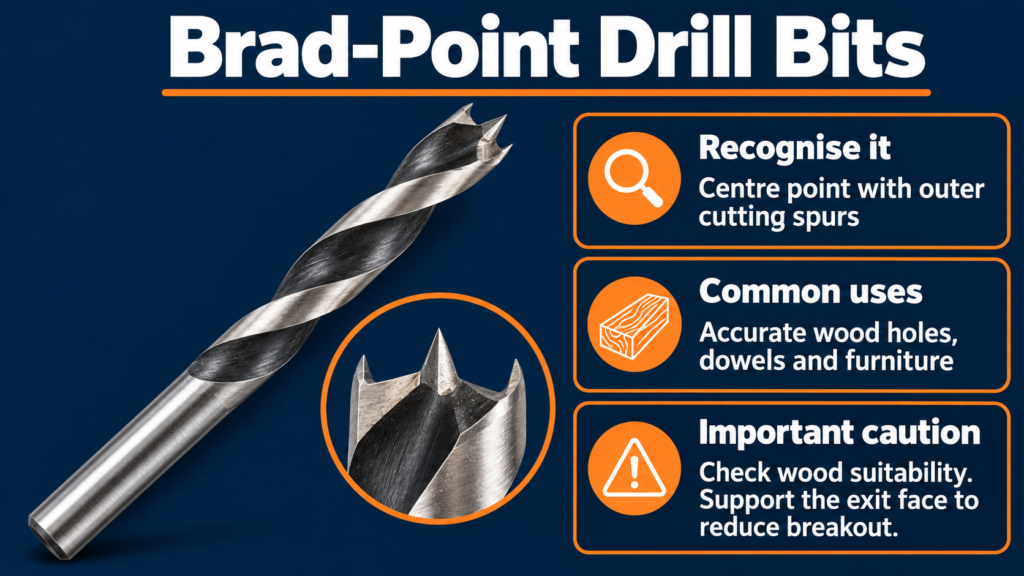
A brad-point bit has a sharp central point and outer cutting spurs.
The centre point helps position the hole, while the spurs cut its perimeter. This makes suitable brad-point bits useful for dowel holes, furniture work and clean holes in timber.
Choose a bit rated for the wood or panel material. Support the workpiece, and use a sacrificial backing board where appropriate to reduce damage as the bit exits.
Brad-point bits are wood-drilling accessories, not substitutes for masonry bits. IRWIN brad-point guidance
3. Spade Bits
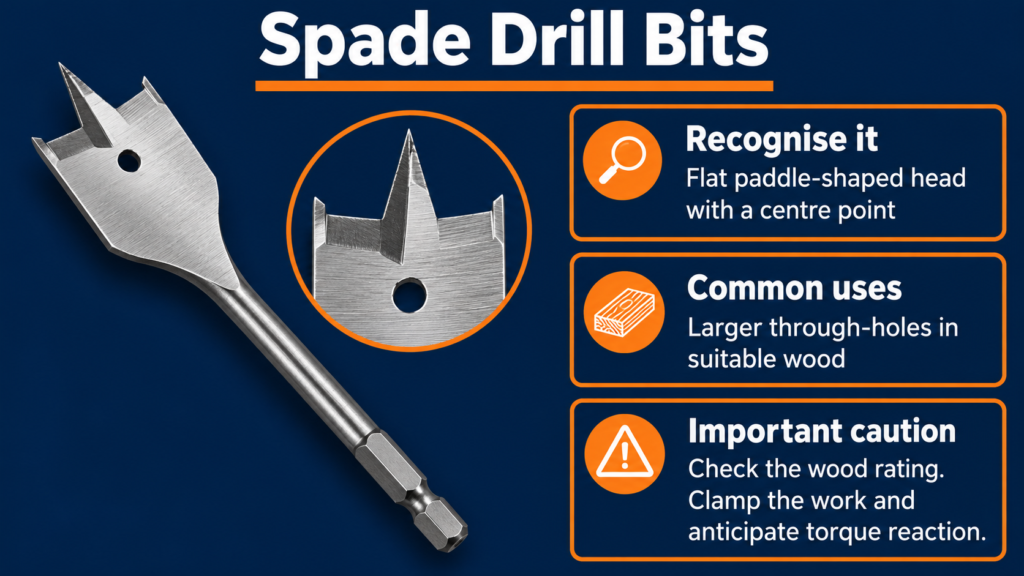
Spade bits have a flat, paddle-shaped cutting head with a centre point. They are commonly used for larger holes in suitable wood, particularly where speed matters more than a fine finish.
Typical applications include openings through timber for cables or other fittings.
Check the exact bit’s material rating. Some spade designs are specified for softwood and particleboard; others include hardwood. A threaded, self-feeding tip can pull the bit into the work, so secure the material and anticipate torque reaction.
Bosch’s specifications illustrate why the individual design matters: its current EXPERT Self Cut Speed listing identifies softwood and particleboard applications. Bosch spade-bit specification
4. Auger Bits
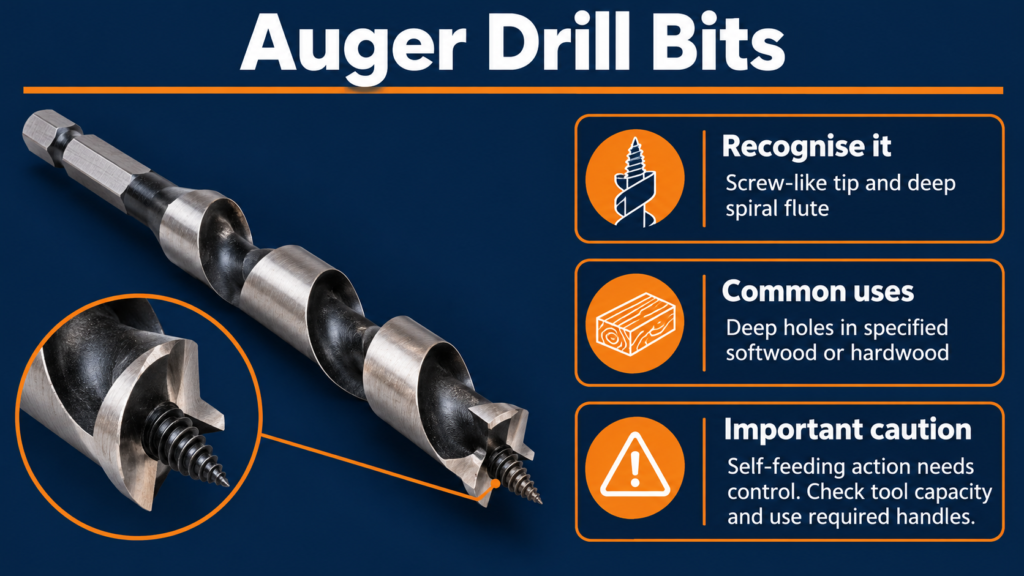
Auger bits commonly have a screw-like centre tip and a pronounced spiral for removing wood chips. Suitable versions are useful for deep holes in softwood or hardwood.
The self-feeding tip helps draw the bit through timber, but it also increases the need for secure workholding and control. Large or deep holes can impose substantial rotational resistance.
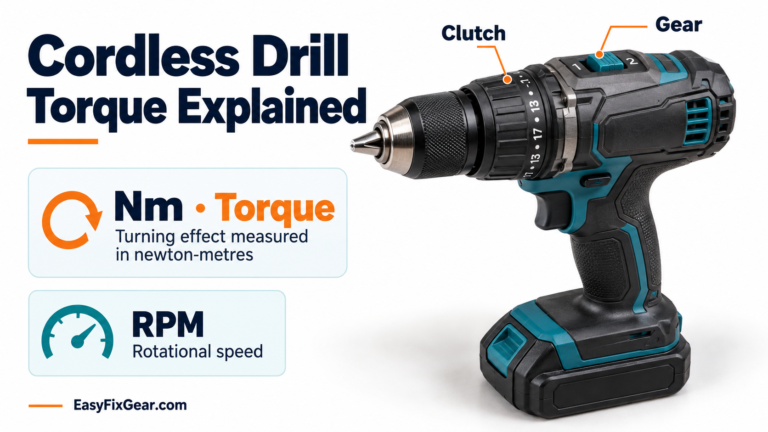
Check the drill’s permitted bit capacity and the accessory’s instructions. Understanding how cordless drill torque works helps explain why gearing, diameter and binding matter alongside the headline Nm rating. Bosch wood-auger guidance
5. Forstner Bits
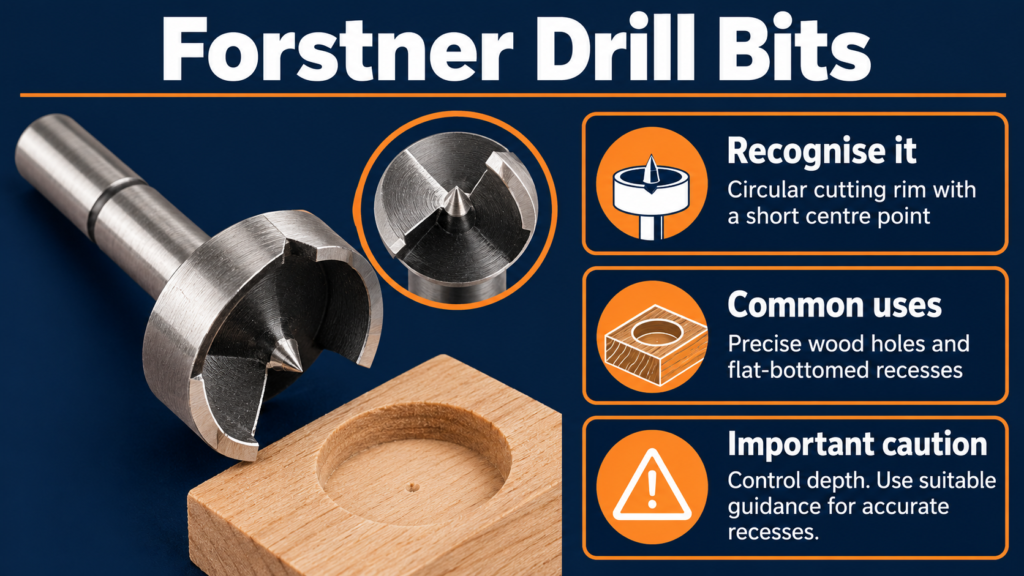
Forstner bits use a circular cutting head to form precise wood holes and substantially flat-bottomed recesses. A small centre-point mark may remain.
They are useful for furniture recesses, including suitable hinge-cup applications, and other holes where the bottom or edge finish matters.
Control depth carefully, particularly in thin furniture panels. Use a drill press or suitable guide where the application requires more control than you can reliably achieve freehand. IRWIN Forstner-bit specification
6. HSS Drill Bits
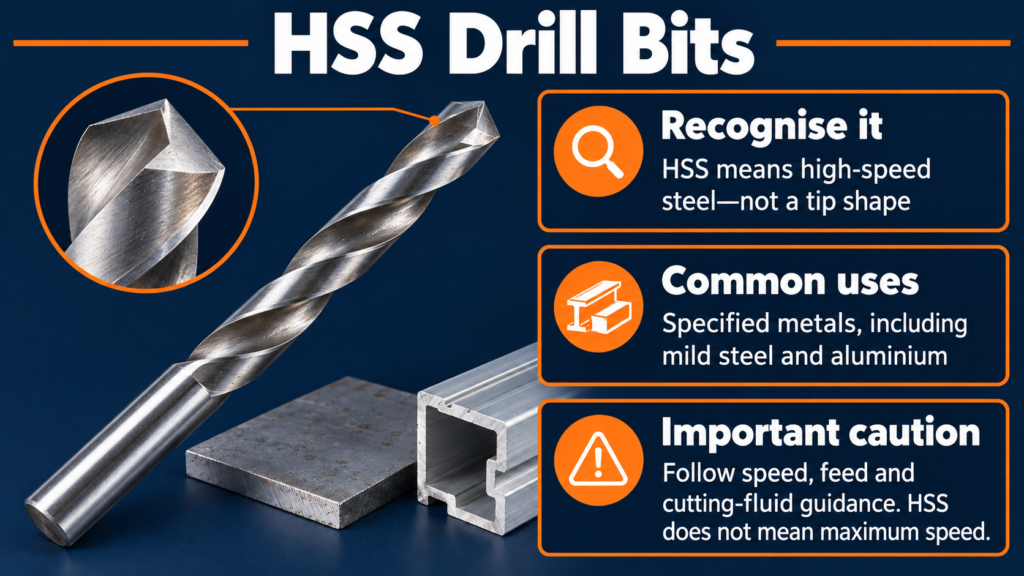
HSS means high-speed steel. It describes the cutting material, not a separate tip shape.
Suitable HSS twist bits are common choices for mild steel, aluminium and other specified metals. Some also suit wood and plastic.
“HSS” does not mean that maximum drill speed is appropriate. Speed, feed pressure and any cutting fluid must suit the material, diameter and accessory.
For a metal bracket, select a metal-rated bit, secure the bracket and use rotary drilling without masonry hammer action. Bosch’s Indian metal-bit range distinguishes ordinary metal-drilling accessories from designs intended specifically for stainless steel. Bosch metal-drilling guidance
7. Cobalt Drill Bits
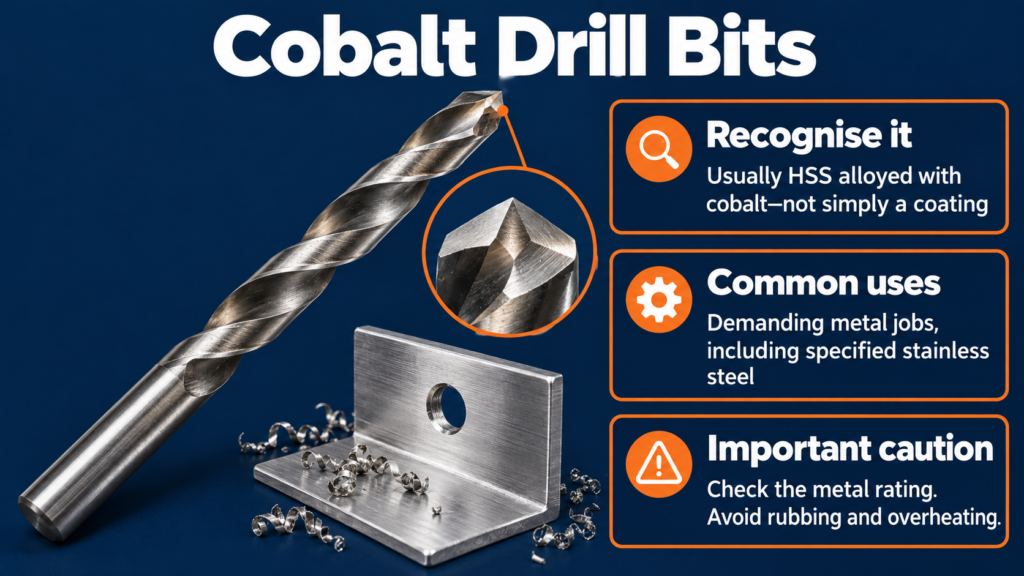
Cobalt drill bits commonly use HSS alloyed with cobalt. The cobalt is part of the alloy rather than simply a coloured surface coating.
Suitable cobalt-alloy bits are commonly chosen for demanding metal drilling, including stainless steel. They still need correct technique: a bit that merely rubs against the surface can generate heat without cutting effectively.
Check the exact alloy, geometry and material rating. “Cobalt” does not make every bit suitable for every hard metal, and sharpening guidance can differ between designs. DEWALT cobalt-alloy explanation
8. Masonry Drill Bits
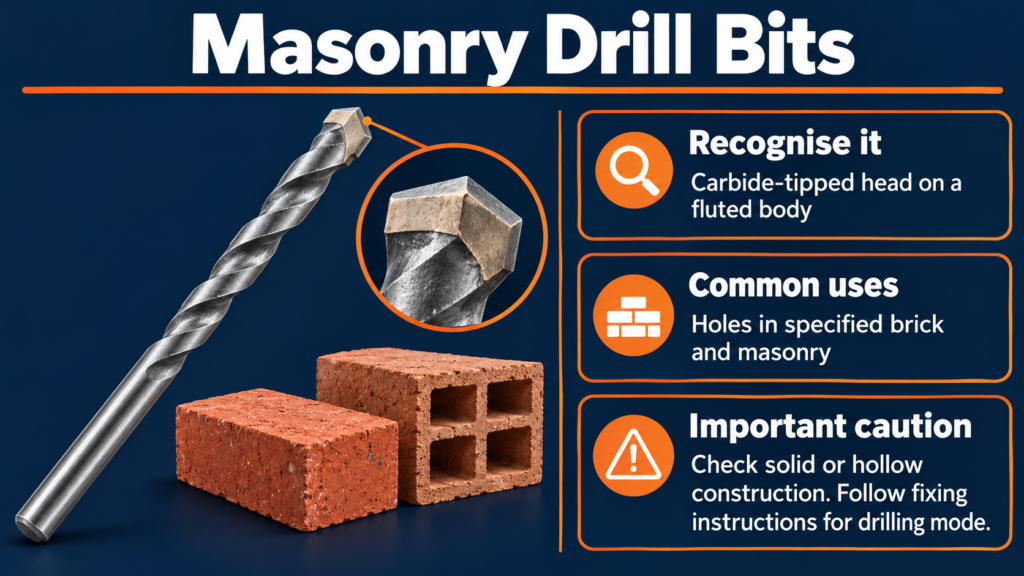
Masonry bits commonly have a carbide-tipped cutting head for specified mineral building materials.
Suitable designs can drill brick, sand-lime brick and certain blocks. Some support rotary drilling, percussion drilling or both.
The correct mode depends on the substrate and fixing instructions. Hollow or fragile masonry can require rotary drilling to preserve the material around the hole; hammer action is not an automatic choice for every wall.
A conventional masonry bit is generally unsuitable for ordinary metal cutting. However, a specifically rated multi-material accessory may cover several materials, so read its specification rather than applying a blanket rule. fischer masonry-bit specification
9. Concrete Drill Bits
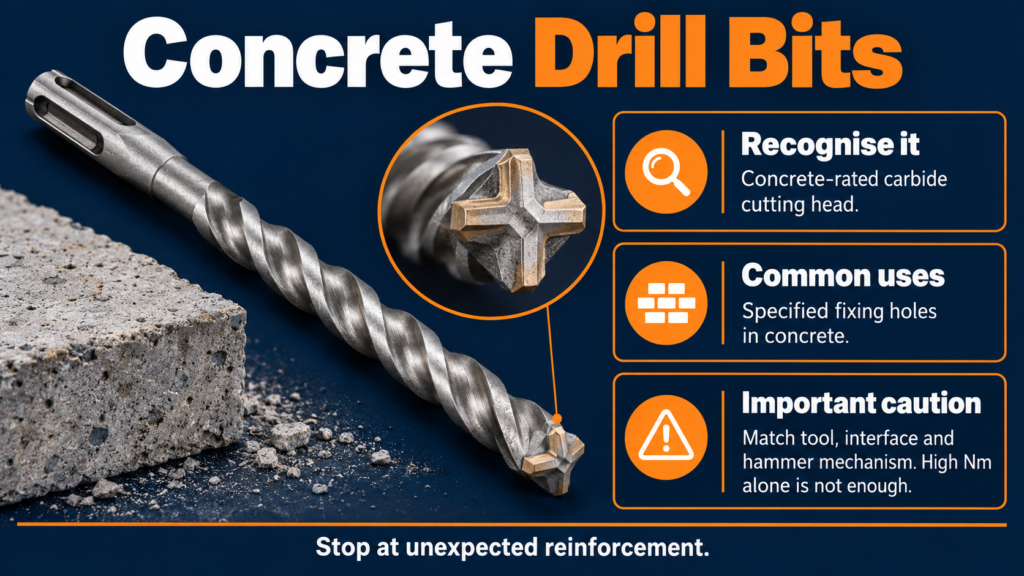
Concrete presents a different challenge from many brick walls. Its hardness, aggregate, hole diameter and drilling depth affect the tool and bit required.
Use a bit explicitly rated for concrete and compatible with the tool’s hammer mechanism. Suitable small holes may be within a hammer drill’s stated capacity. Harder concrete, deeper or larger holes, and repeated work commonly call for a suitable rotary hammer.
A hammer drill adds forward percussion to rotation. A rotary hammer uses a different hammering mechanism, commonly with an SDS interface, for more demanding work. DEWALT hammer-drill explanation, Hilti rotary-hammer applications
A cordless drill with a high Nm rating does not automatically become a suitable concrete-drilling tool. Rotational torque cannot replace the required bit, hammer mechanism or drilling capacity.
If you encounter unexpected metal or suspect reinforcement, stop and establish what you have reached. A bit advertised for reinforced concrete does not establish that drilling through a structural element is appropriate.
10. SDS Drill Bits
Think of SDS as a matching connection between an accessory and a tool.
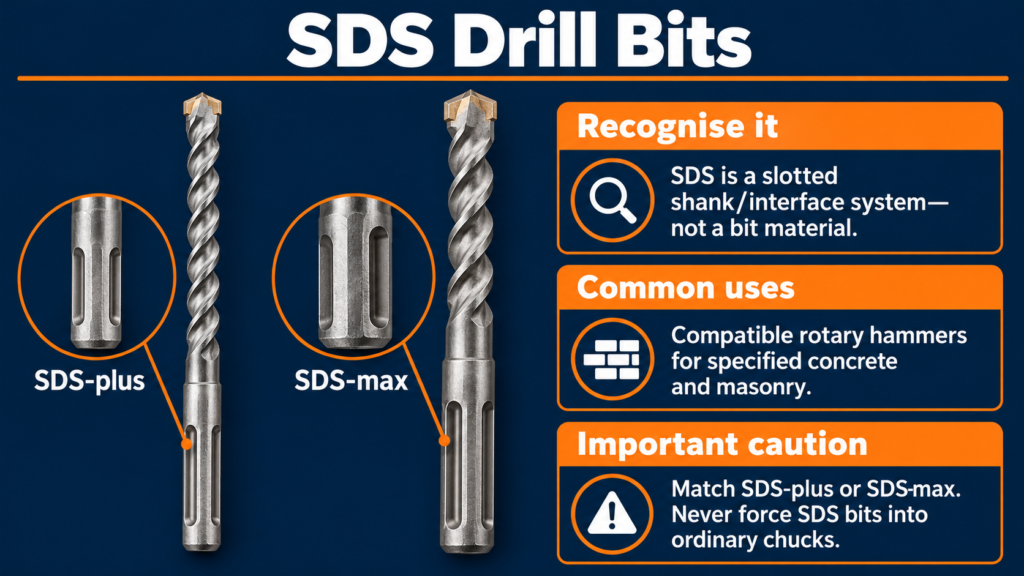
The shank has slots or grooves that engage with a compatible holder. The system retains the accessory and transmits drive while accommodating the movement needed for hammering.
SDS describes a shank/tool interface system. SDS is not a drill-bit material.
Homeowners mainly need to recognise two versions:
- SDS-plus: commonly found on smaller and medium rotary hammers used for masonry and concrete drilling.
- SDS-max: commonly found on larger machines for heavier drilling and chiselling.
They are different interfaces. Check the tool and accessory markings.
An SDS bit requires a compatible holder. Do not force an SDS shank into an ordinary three-jaw drill chuck. Any alternative chuck or adapter must be expressly approved for the tool, accessory and operating mode. DEWALT SDS explanation, Hilti SDS-plus applications, Hilti SDS-max applications
11. Drill Bits for Tile
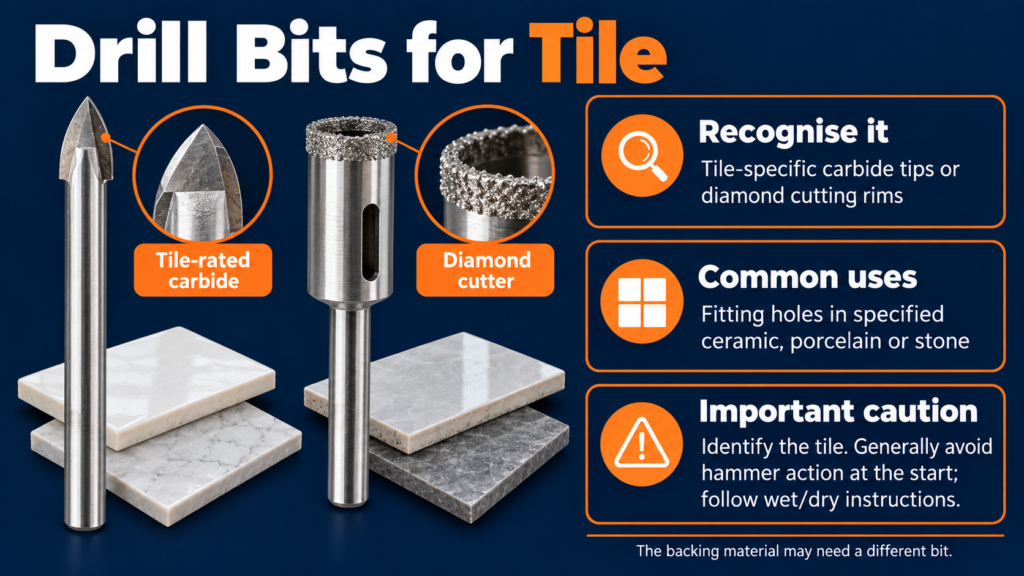
Tile requires careful identification because ceramic, porcelain, and natural stone do not all drill in the same way.
| Tile material | Commonly suitable approach | Main check |
|---|---|---|
| Ceramic tile | Tile-specific carbide bit or suitable diamond cutter | Confirm suitability for the tile’s hardness and thickness |
| Porcelain tile | Porcelain-rated carbide tile bit or suitable diamond drilling system | An ordinary soft-tile bit may be unsuitable |
| Natural stone | Stone-rated diamond cutter or another explicitly approved bit | Identify the stone and check the required method |
Manufacturer guidance supports both carbide tile bits for specified hard ceramics and diamond hole cutters for suitable tiles and stone. These are different solutions with different instructions. Bosch tile-drilling guidance, Bosch diamond tile-hole-saw specification
Tile can crack if drilled incorrectly. Excessive pressure, heat, slipping and inappropriate hammer action can damage it.
For initial tile penetration, generally use controlled rotary drilling without hammer action unless the particular manufacturer and system explicitly specify otherwise.
Cooling is accessory-specific. Some systems require wet use; others are designed for dry drilling. Never assume that all diamond bits need water or all tile bits can run dry. Use water only with a tool and setup approved for that application. Bosch wet-use tile-hole-saw instructions
After penetrating the tile, identify the backing material:
Tile → masonry substrate may require changing to an appropriate masonry bit and selecting a different mode. Avoid allowing the replacement bit or its hammer action to damage the tile opening.
12. Drill Bits for Glass
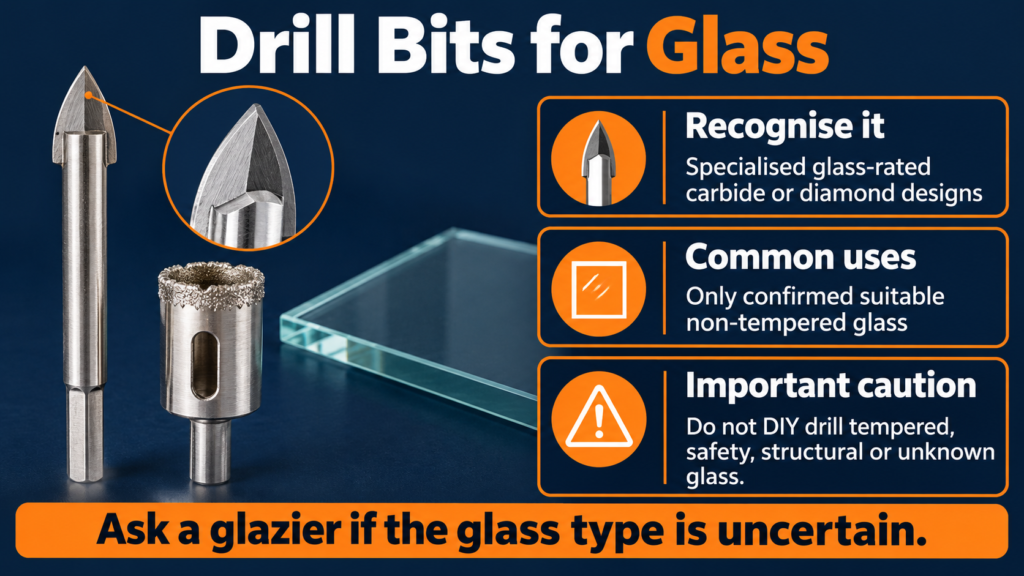
Some specialised carbide glass/tile bits and diamond systems are designed for suitable non-tempered glass. Confirm the glass type and the accessory’s instructions before considering the job.
Glass is fragile. It needs supported, controlled drilling with the specified pressure, speed and cooling method—not ordinary masonry hammering. Bosch specifies particular glass/tile accessories for non-tempered glass and drilling without impact. Bosch glass/tile-bit guidance
Do not attempt to drill tempered/toughened glass, safety glazing, structural glazing or unknown glass yourself. Toughened glass must be drilled before toughening; it cannot safely be treated as ordinary drillable glass after manufacture. Ask a glazier to assess the material and arrange an appropriate replacement or professionally prepared piece. Pilkington toughened-glass guidance
13. Hole Saws
A hole saw cuts a circular ring, leaving a removable centre plug. It is useful for larger-diameter openings.
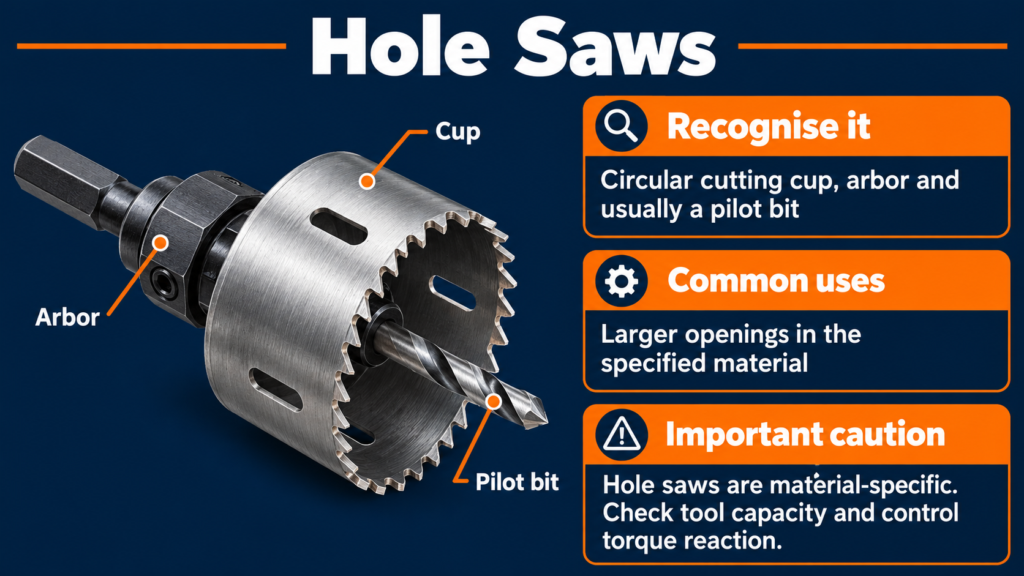
A typical assembly contains:
- Cup or cutting section: the toothed or abrasive rim that forms the hole.
- Arbour: the connection supporting the cutter and attaching it to the tool.
- Pilot bit: the central bit that locates and guides many conventional hole saws.
Some specialist diamond systems use a different guiding arrangement, so follow the complete system’s instructions.
Hole saws are material-specific. A wood cutter is not automatically suitable for metal, tile or masonry. Check cutter depth, arbour compatibility, tool capacity and the required mode. Larger cutters also increase the importance of controlling torque reaction. Bosch pilot-bit and arbour guidance
14. Step Drill Bits
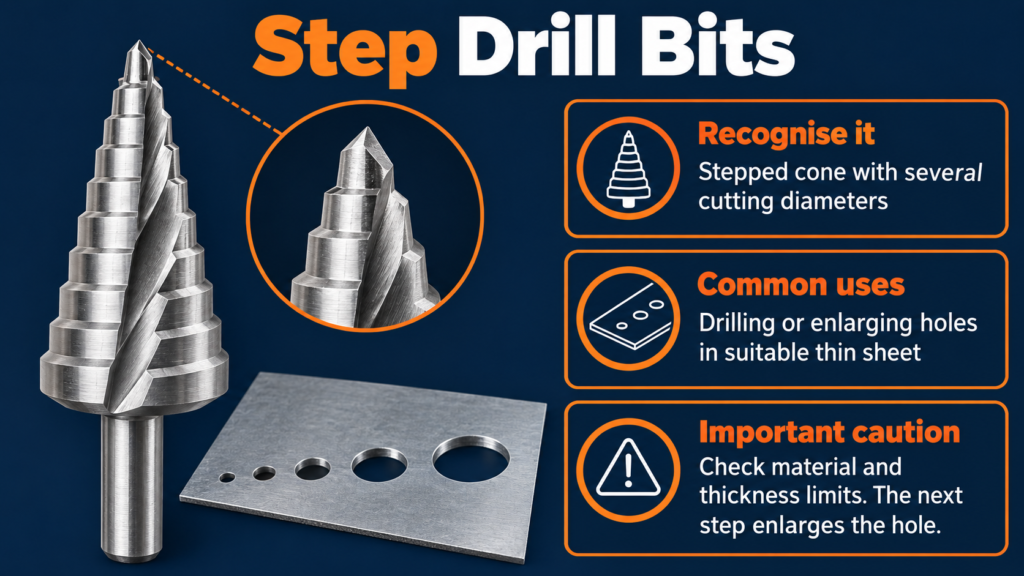
A step drill has a cone-shaped body with successive cutting diameters. Each step produces a particular hole size.
Suitable versions are useful for drilling or enlarging holes in thin sheet metal and certain plastics or laminates.
Check the permitted material and thickness. The usable depth of a diameter step limits the thickness through which it can produce a straight-sided hole; pushing farther engages the next, larger step.
Some step bits are self-starting, while others require a pilot hole. They are not general-purpose substitutes for deep twist drilling. IRWIN step-bit applications, IRWIN pilot-hole requirement example
15. Countersink Bits
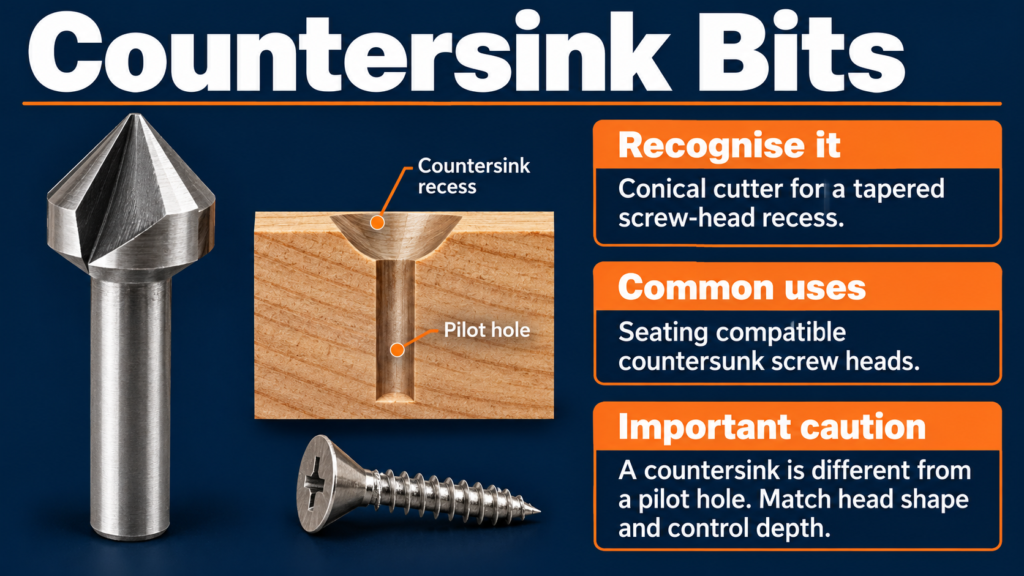
A countersink forms a tapered recess around a hole so that a compatible countersunk screw head can sit flush with, or appropriately below, the surface.
These are separate operations:
- Pilot drilling: creates a hole to guide and accommodate the screw.
- Countersinking: creates a recess for the screw head.
A combination accessory can perform both, but each part still has a different purpose.
Match the countersink to the material and screw-head geometry. Do not remove excessive material, particularly in thin panels. Some fasteners have self-countersinking features; follow their instructions. Bosch screw-fastening illustration
What Is a Pilot Hole and When Do You Need One?
A pilot hole is a deliberately drilled hole that helps guide a screw or, in certain drilling operations, a larger cutting accessory.
For screwdriving, an appropriate pilot hole can:
- Guide the screw along the intended line.
- Reduce the risk of splitting.
- Improve positioning.
- Reduce driving resistance.
- Reduce the torque needed to drive some fasteners.
Pilot holes are especially worth checking for hardwood, larger screws, thin pieces and positions close to an edge. Some screws are designed to work without pre-drilling in specified materials, so follow the fastener instructions. SPAX pre-drilling guidance
How Do You Choose the Pilot-Hole Size?
There is no universal formula for every screw.
The appropriate diameter depends on the screw type, nominal diameter, thread and root/core dimensions, material, and manufacturer guidance. Screw depth and the joint arrangement also matter.
An undersized hole may leave excessive resistance. An oversized hole may reduce thread engagement.
For a joint joining two pieces, a clearance hole in the upper piece may also be needed. That allows the screw to pass through the upper piece while engaging the receiving piece below. A clearance hole is different from a pilot hole.
Pilot drilling is one reason a difficult screw does not always require a more powerful drill. See understanding cordless drill torque for the relationship between resistance, gearing and clutch control.
How Drill Bit Sizes Work
For Indian household DIY, metric sizes in millimetres are the main reference.
| Specification | Meaning |
|---|---|
| Bit diameter | The nominal cutting diameter |
| Working length | The specified usable working portion of the bit |
| Overall length | The total length, including the shank |
| Shank diameter or interface | The portion that must fit the tool |
Diameter and length are separate specifications. Two 6 mm bits may have different working lengths and overall lengths.
Working length is not necessarily a guarantee that you can drill a clean hole to that entire depth in every setup. Chip removal, tool access, material and accessory instructions still matter.
Manufacturer listings commonly show these dimensions separately. Bosch dimensional specification example
Imported accessories and online advice may use fractional inches. For example, ¼ inch equals 6.35 mm, not 6 mm. Do not substitute a nearby fractional size where a fixing requires a specified metric hole.
What Size Drill Bit Should You Use for a Wall Plug?
Use the fixing or anchor manufacturer’s specified hole diameter for the intended substrate.
Some ordinary plastic plugs have a specified hole diameter matching their nominal size. That does not establish a universal rule for every anchor.
For example, Fischer specifies a 6 mm drill diameter and 40 mm minimum hole depth for its DuoPower 6 × 30 variant. This is a product-specific example, not permission to apply those dimensions to another fixing. Fischer DuoPower 6 × 30 specification
Check:
- The exact fixing model.
- Whether it is suitable for brick, concrete, block or hollow material.
- The required hole diameter and depth.
- The permitted drilling mode.
- Hole-cleaning and installation instructions.
- The specified screw or other fastener.
A worn bit, excessive wobble or damaged substrate can produce an unsuitable hole even when the nominal diameter is correct.
If the hole is oversized, crumbling or otherwise damaged, stop and follow an approved remedy. Do not improvise structural anchoring from a general drill-bit guide.
Drill Bit Shanks Explained
The shank is the connection end.
| Shank type | What to recognise | Compatibility consideration |
|---|---|---|
| Round | Cylindrical gripping section | Usually intended for a suitable three-jaw chuck |
| Hex | Six-sided gripping section | May fit a suitable chuck or matching hex holder; size and retention shape matter |
| Reduced shank | Shank smaller than the cutting diameter | Allows certain larger cutters to fit a smaller chuck, within tool limits |
| SDS | Slotted or grooved connection | Requires the matching SDS holder/system |
Reduced-shank accessories are established designs, but their smaller connection does not increase the drill’s rated drilling capacity. IRWIN accessory categories
Remember the distinction:
The cutting end determines how the bit works with the material. The shank determines how it connects to the tool.
Material compatibility and drill compatibility are two separate questions.
Will This Drill Bit Fit My Drill?
Common drill-chuck capacities include 10 mm and 13 mm, although the minimum opening also varies.
For example, Bosch lists a 0.8–10 mm range for its GSR 120-LI and a 1.5–13 mm range for the referenced GSR 18V-65. Check your own model. Bosch 10 mm chuck specification, Bosch 13 mm chuck specification
Keyless and Keyed Chucks
A keyless chuck tightens through its sleeve according to the tool’s instructions. A keyed chuck uses a chuck key.
Both commonly use three jaws, but capacity and approved accessories still matter. Remove the chuck key before starting.
Cutting Diameter Is Not Shank Diameter
A bit that cuts a 16 mm hole does not necessarily have a 16 mm shank. It could have a reduced round shank, hex shank or SDS connection.
Likewise, a 13 mm chuck does not establish that the drill can handle every accessory whose shank fits it.
Before buying or installing a bit, check:
Interface → gripping dimensions → accessory suitability → tool drilling capacity → operating mode.
Can You Use Drill Bits in an Impact Driver?
Sometimes, use accessories expressly suitable for the tool and task.
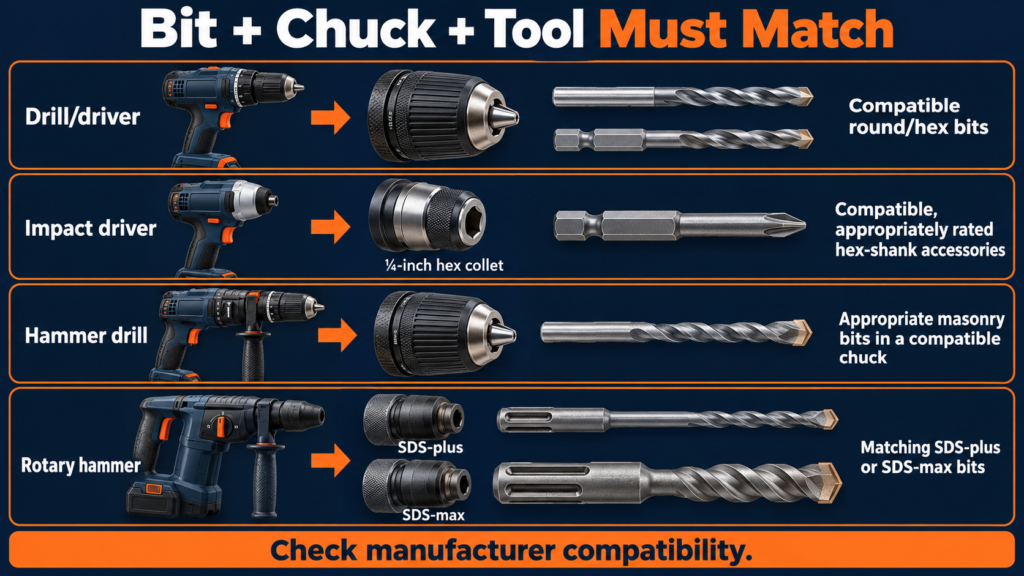
A drill/driver provides rotary drilling and commonly has a three-jaw chuck. An impact driver typically has a ¼-inch hex collet and delivers rotational impacts when resistance rises. These twisting impacts differ from a hammer drill’s forward percussion. DEWALT impact-mechanism explanation
Use compatible hex-shank drilling accessories approved for impact-driver use. Where impacting is expected, check the impact rating.
Do not insert an ordinary round-shank bit directly into an impact-driver collet. A chuck adapter must be compatible, appropriately rated and suitable for the intended operation.
Physical fit alone is insufficient. Delicate tile, glass and precision work may require controlled rotary drilling with another tool unless the accessory manufacturer explicitly supports the proposed system.
Some wood bits are expressly impact-rated, showing why the individual specification matters. Bosch impact-rated spade-bit example
Drill, Hammer Drill or Rotary Hammer: Which Bits Fit?
| Tool | Common Bit Interface | Typical Use | Important Limitation |
|---|---|---|---|
| Drill/driver | Three-jaw chuck accepting suitable round or hex shanks | Wood, metal, pilot holes and screwdriving | No forward hammer mechanism; observe material and diameter capacities |
| Hammer drill/driver | Usually a three-jaw chuck | Ordinary rotary drilling and suitable masonry percussion drilling | Hammer mode can damage unsuitable materials; demanding concrete may exceed capacity |
| Impact driver | Typically ¼-inch hex collet | Fastening and approved hex-shank drilling accessories | Rotational impacts do not replace masonry hammering |
| Rotary hammer | Commonly SDS-plus or SDS-max | Suitable for concrete and masonry drilling | Match the exact interface; alternative chucks and modes require approval |
Successful drilling needs compatibility among:
Tool + chuck/interface + bit + material.
Corded or cordless power is a separate choice from tool mechanism. Our cordless vs corded drill guide explains the workload and convenience considerations.
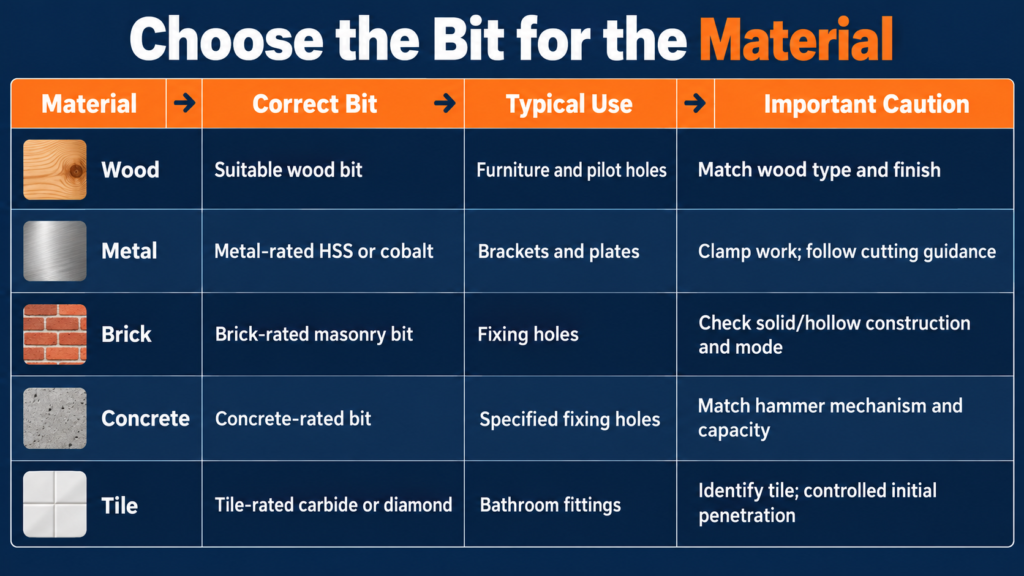
Which Drill Bit Should You Use for Each Material?
| Material | Recommended Bit Type | Typical Use | Important Caution |
|---|---|---|---|
| Softwood | Suitable brad-point or HSS twist bit | Pilot holes, furniture | Match the design to the required finish |
| Hardwood | Hardwood-rated brad-point, auger or Forstner | Furniture, dowels and recesses | Not every spade bit is hardwood-rated; check pilot-hole requirements |
| Plywood/MDF | Panel-suitable brad-point or twist bit | Furniture fittings and access holes | Support the exit face; avoid breakout and control panel dust |
| Mild steel | Suitable HSS twist bit | Brackets, plates and bolt holes | Clamp securely; follow speed, feed and cutting-fluid guidance |
| Stainless steel | Stainless-rated cobalt-alloy HSS bit | Brackets and fittings | Avoid prolonged rubbing and overheating |
| Aluminium | Aluminium-rated HSS twist bit; suitable step bit for thin sheet | Profiles, brackets and sheet openings | Check chip removal and lubrication guidance |
| Thin sheet metal | Suitable step bit or sheet-metal twist bit | Clean openings and hole enlargement | Respect thickness limits; secure the sheet against spinning |
| Brick | Brick-rated carbide-tipped masonry | Non-structural fixing holes | Identify solid versus hollow brick and follow the fixing’s drilling-mode instructions |
| Concrete | Concrete-rated carbide bit matched to a suitable hammer drill or rotary hammer | Specified fixing holes | Hardness, diameter and depth affect tool choice; stop at unexpected reinforcement |
| Concrete block | Block-rated masonry | Suitable fixing holes | Hollow, dense and lightweight blocks require different fixing |
| Ceramic tile | Ceramic-rated carbide tile bit or suitable diamond system | Bathroom and kitchen fittings | Controlled initial penetration; generally avoid hammer action |
| Porcelain tile | Porcelain/hard-tile-rated carbide bit or suitable diamond system | Holes through dense tile | A soft-ceramic bit may be unsuitable |
| Glass | Glass-rated specialist bit for confirmed suitable non-tempered glass | Limited non-structural applications | No DIY drilling of tempered/safety glass, structural glazing |
| Plastic | Plastic-rated twist bit; suitable step bit for thin sheet | Panels, covers and fittings | Plastic types differ; control heat, grabbing and cracking |
Choosing Drill Bits for Common Indian Home DIY Jobs
Installing a Shelf on a Brick Wall
Follow this sequence:
Identify wall material → choose an appropriate masonry bit → check fixing manufacturer’s hole diameter → choose the specified drill mode → drill safely.
Confirm that the drilling point is brick rather than only plaster, and establish whether the brick is solid or hollow. Check concealed services before drilling.
Select the fixing for the substrate and intended use. The bit diameter follows that fixing’s instructions, not the screw head or a visual guess.
Drilling a Concrete Wall
First, determine whether the location is appropriate to drill, then check hole diameter and depth.
Choose a concrete-rated bit and suitable hammer mechanism within the tool’s capacity. A harder or more demanding job may require a rotary hammer.
Buying a cordless drill with more Nm does not solve a mismatch between concrete, bit and hammer mechanism. If you need help choosing the tool category, see best cordless drills for home use in India.
Assembling Furniture
Identify solid wood, plywood, MDF or particleboard and follow the furniture instructions.
Use an appropriate wood-drilling bit for new holes or pilot holes. Then change to a screwdriver bit matching the screw recess.
Use clutch control for screwdriving and increase the setting only as necessary. Do not force a screw into a poorly positioned hole or modify factory-drilled furniture holes without understanding the fitting.
Drilling Bathroom Tile
Follow:
Identify tile → choose the appropriate tile bit → make controlled initial penetration → identify the substrate → change bit or mode if necessary.
Check for concealed plumbing and wiring. A visible tile surface does not reveal every service behind it.
Keep the masonry stage clear of the tile edges, and follow the fixing instructions for the complete wall construction.
Drilling a Metal Bracket
Choose a bit rated for the bracket’s metal and the required diameter.
Clamp the bracket securely. Select the recommended rotary drilling technique, speed and any appropriate cutting fluid. Reduce feed near breakthrough and manage sharp burrs safely.
Never hold a small bracket in one hand while drilling it with the other. CCOHS drilling guidance
Drill Bit Material vs Coating
Bit material ≠ bit coating.
| Term | What it describes | Practical meaning |
|---|---|---|
| HSS | High-speed steel cutting material | Common in suitable metal twist bits |
| Cobalt alloy | Cobalt incorporated into the steel alloy | Used in suitable demanding metal-drilling designs |
| Carbide/carbide-tipped | Carbide cutting material or a carbide head/tip attached to a body | Found in several different accessory families |
| Titanium-based coating | A surface treatment, such as titanium nitride | Performance depends on the coating, base material and application |
| Diamond abrasive/cutting system | Diamond particles or segments forming the cutting surface | Used in suitable tile, stone and other specialised cutters |
A titanium-nitride-coated bit is not a solid titanium drill bit. DEWALT documents TiN-coated accessories for specified non-ferrous-metal, wood and plastic applications. That does not establish that “titanium drill bits are always better.” DEWALT TiN specification
Intended material, geometry, manufacturing quality and technique also matter. Do not assume that every gold-coloured bit has a particular coating.
Why Drill Bits Become Dull or Overheat
Poor cutting can result from several interacting causes:
| Possible cause | What to check |
|---|---|
| Wrong bit for the material | Confirm the material rating |
| Incorrect speed | Follow guidance for the material and diameter |
| Excessive pressure | Use controlled feed; do not force a stalled cutter |
| Worn cutting edges | Inspect before continuing |
| Poor chip or dust removal | Follow the accessory’s clearing procedure |
| Inadequate cooling or lubrication | Use only the specified method |
| Prolonged demanding use | Observe duty limits and let the system cool as instructed |
A bit that rubs instead of cutting can produce substantial heat. More pressure is not always the remedy.
There is no universal drilling lubricant. A metal-cutting fluid, a wet diamond system and a dry tile bit have different requirements. Do not add water or oil to an operation without confirming material, accessory and tool suitability.
Manufacturer guidance also warns that excessive pressure can bend long bits and cause breakage or loss of control. Makita long-bit safety instructions
When Should You Replace a Drill Bit?
Stop using a bit with:
- Chipped cutting edges or damaged carbide tips.
- A bent body.
- A cracked, damaged or badly worn shank.
- Persistent poor cutting despite correct setup.
- Excessive wobble attributable to the bit.
- Repeated overheating despite an appropriate bit and technique.
Wobble can also originate in installation or the chuck. Stop and identify the cause.
Some accessories can be professionally sharpened according to their manufacturer’s instructions. Others cannot. Do not try to compensate for damage with extra speed or pressure.
Common Drill Bit Mistakes
| Mistake | Better approach |
|---|---|
| Using a wood bit on masonry | Choose a bit specified for the wall material |
| Using a conventional masonry bit on metal | Choose a metal-cutting bit or expressly rated multi-material accessory |
| Choosing by colour alone | Read the specification |
| Assuming every gold bit is titanium-coated | Verify the documented coating |
| Using inappropriate hammer mode on tile | Follow the tile system’s instructions |
| Attempting demanding concrete drilling with an unsuitable drill | Match the hammer mechanism and capacity |
| Ignoring chuck compatibility | Check shank size and interface |
| Confusing SDS with a material | Treat SDS as the connection system |
| Forcing SDS bits into ordinary chucks | Use the matching compatible holder |
| Using dull or damaged bits | Inspect and replace or service appropriately |
| Applying excessive pressure | Investigate poor cutting first |
| Ignoring pilot holes | Check the screw and material requirements |
| Guessing wall-plug hole size | Follow the exact fixing instructions |
| Leaving portable workpieces unsecured | Clamp them against movement and spinning |
Drill Bit Safety: Before You Start Drilling
Safety Box
Identify the material and concealed services, inspect the bit, confirm compatibility, secure the work and select the correct mode. Wear eye protection. Stop if the bit binds or behaves unexpectedly. Treat recently used bits as hot.
Before starting:
- Wear eye protection and task-appropriate hearing and dust protection.
- Secure portable workpieces.
- Inspect the bit, chuck and tool.
- Secure loose clothing and hair; keep them away from rotating parts.
- Disconnect power or remove the battery as instructed before changing accessories.
- Seat and tighten the bit correctly.
- Remove the chuck key from a keyed drill.
- Select the appropriate mode.
- Maintain a stable stance.
- Use the side handle where required.
- Anticipate torque reaction, especially with larger cutters.
- If the bit binds, release the trigger and follow the tool’s safe removal procedure.
- Allow hot accessories to cool before handling.
These precautions align with CCOHS powered-drill guidance and manufacturer warnings about binding and torque reaction.
For wall drilling, check for concealed electrical wiring, plumbing, gas lines where applicable and other building services. Use appropriate detection and available building information; a detector alone does not guarantee a clear drilling route.
Control masonry dust with a suitable extraction setup. Do not proceed into unidentified potentially hazardous building materials.
When You Should Not Drill It Yourself
Arrange qualified help when:
- Concealed services remain uncertain.
- The location may involve structural concrete, beams, columns or reinforcement.
- The job involves large structural anchors or safety-critical fixings.
- Glass is tempered, safety-related, structural or unidentified.
- Tile or stone is valuable, difficult to replace or outside your experience.
- Building materials may contain hazardous substances.
- The hole exceeds your tool’s capacity.
- You cannot secure the work or control the tool safely.
Getting the material or fixing assessed first is often simpler than repairing a damaged surface or unsuitable hole.
How to Choose the Right Drill Bit
What material?
Wood / Metal / Brick / Concrete / Tile / Other
What size hole? Or what type of hole?
Pilot / Through-hole / Large hole / Anchor
What tool?
Drill / Hammer drill / Rotary hammer / Impact driver
What chuck/interface?
Round / Hex / SDS
Choose compatible bit → Check drill mode → Check safety → Drill
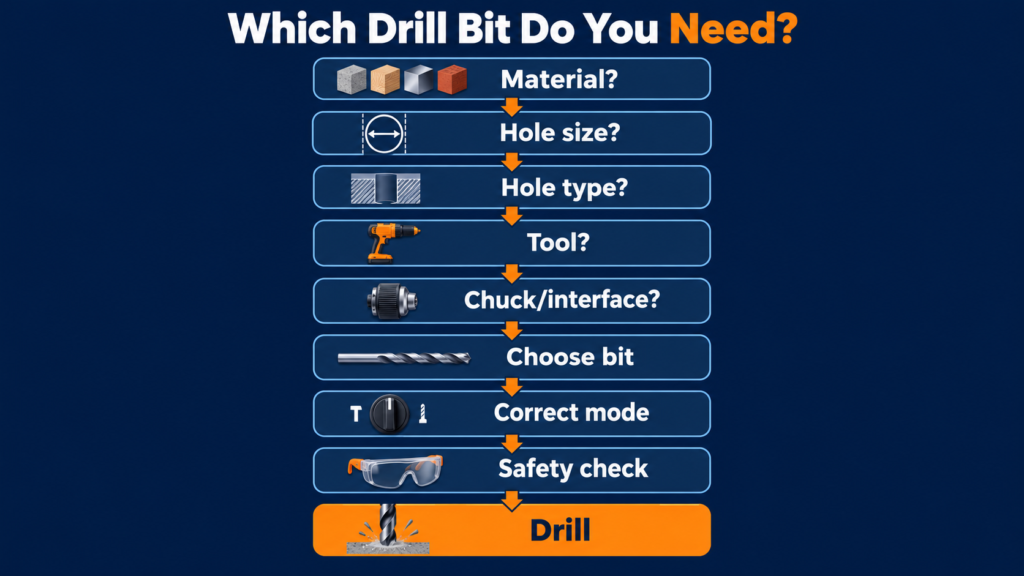
If a choice reveals a mismatch, return to the relevant step. A bit that fits physically may still be unsuitable for the material or tool’s capacity.
Types of Drill Bits: What Should You Remember?
Understanding the types of drill bits means recognising both their purpose and their limits.
Start with the material, choose the cutting design, establish the required diameter and depth, check the shank and chuck, select the appropriate tool and mode, and complete the safety checks.
Material first → bit type → size → shank/chuck compatibility → tool/mode → safety.
Owning many drill bits matters less than selecting the correct bit for the material and task.
Frequently Asked Questions
1. What are the main types of drill bits?
Common categories include twist, brad-point, spade, auger, Forstner, masonry, concrete and specialist tile/glass bits, plus hole saws, step bits and countersinks. HSS and cobalt describe materials; SDS describes a connection system, so the categories overlap.
2. Which drill bit should I use for wood?
A suitable brad-point bit commonly suits accurate holes. Wood-rated spade or auger bits suit certain larger or deeper holes, while Forstner bits suit recesses. Choose according to the wood, hole size and finish required.
3. Which drill bit should I use for metal?
Use a bit rated for the metal involved. HSS twist bits commonly suit mild steel and aluminium; suitable cobalt-alloy or other stainless-rated bits suit stainless steel. Thin sheet may suit an approved step bit.
4. Which drill bit should I use for a brick wall?
Use a brick-rated masonry or suitable multi-material bit. Identify solid or hollow brick and follow the fixing manufacturer’s diameter, depth and drilling-mode instructions.
5. Which drill bit should I use for concrete?
Use a concrete-rated bit compatible with an appropriate hammer drill or rotary hammer. Concrete hardness, hole diameter, depth and tool capacity determine the combination. High torque alone does not establish suitability.
6. Can I use a masonry bit on tile?
Do not assume a conventional masonry bit is suitable. Use a tile-rated accessory matched to ceramic, porcelain or stone, and generally avoid hammer action during initial penetration unless the specific system permits it.
7. What size drill bit should I use for a wall plug?
Use the exact fixing manufacturer’s specified hole diameter and substrate instructions. Check depth, drilling mode and cleaning requirements too; matching the plug’s nominal size is not a universal rule.
8. What is the difference between HSS and cobalt drill bits?
HSS means high-speed steel. Cobalt bits commonly use HSS alloyed with cobalt for demanding metal applications. Cobalt is part of that alloy rather than simply a coating; suitability still depends on the design.
9. Can every drill bit fit every drill?
No. Check shank size, chuck capacity, interface, accessory rating and tool capacity. Three-jaw chucks, hex collets, SDS-plus and SDS-max are different connections.
10. What is the difference between a normal drill bit and an SDS bit?
An SDS accessory has a slotted shank for a compatible SDS holder. SDS describes the connection, not the cutting material. Do not force an SDS bit into an ordinary three-jaw chuck.
Last updated: 4 October 2026