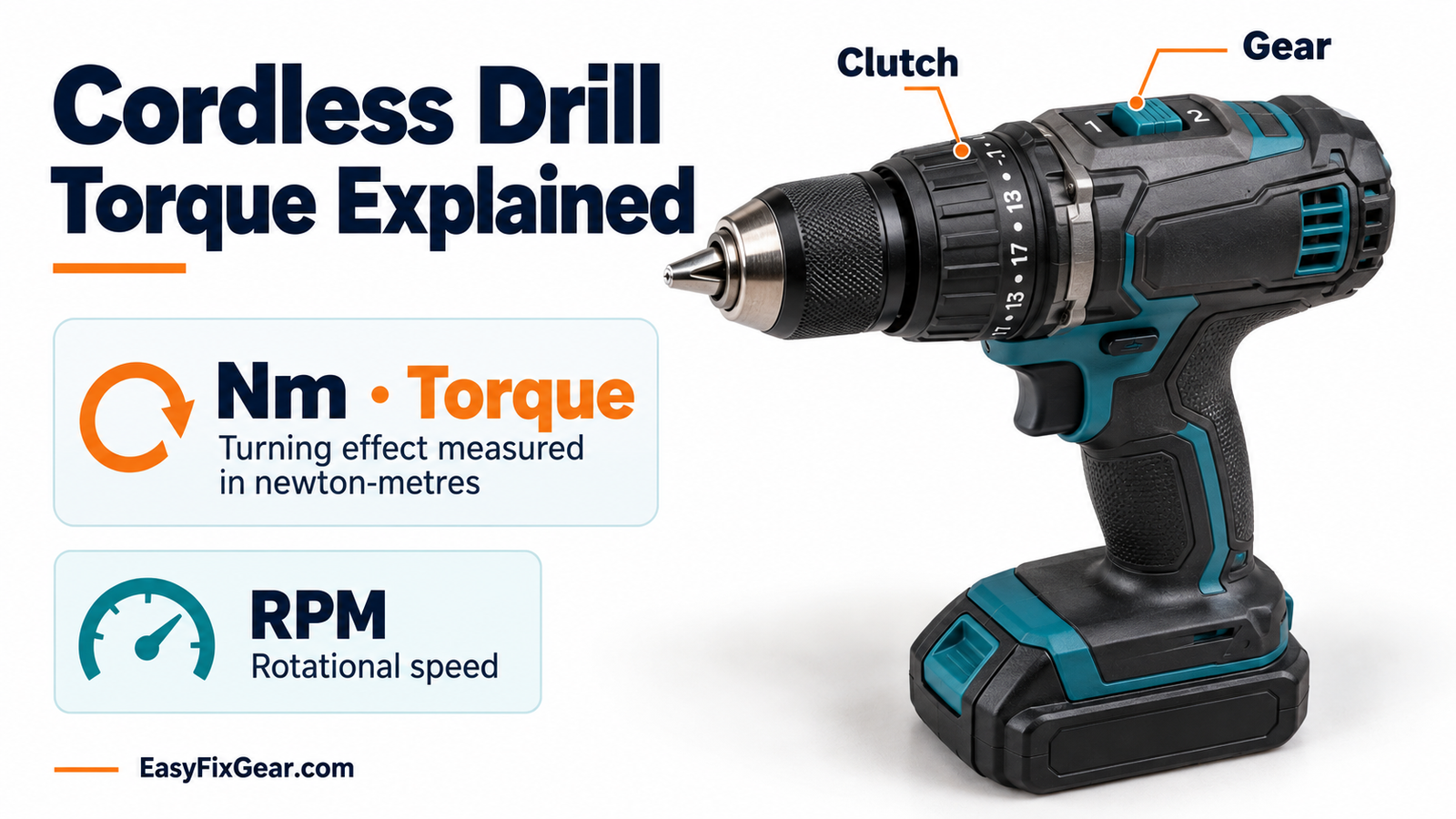
A buyer sees cordless drills advertised at 35 Nm, 45 Nm, 55 Nm and 65 Nm, then assumes the largest number identifies the best drill. Understanding cordless drill torque means looking beyond that number.
Maximum torque tells you something useful about a drill’s turning capability. It does not tell you how gently it drives furniture screws, how well it maintains drilling speed, or whether it has the right mechanism for concrete.
For household DIY, the useful combination is torque, speed, gears, clutch control, suitable bits and the correct tool for the material.
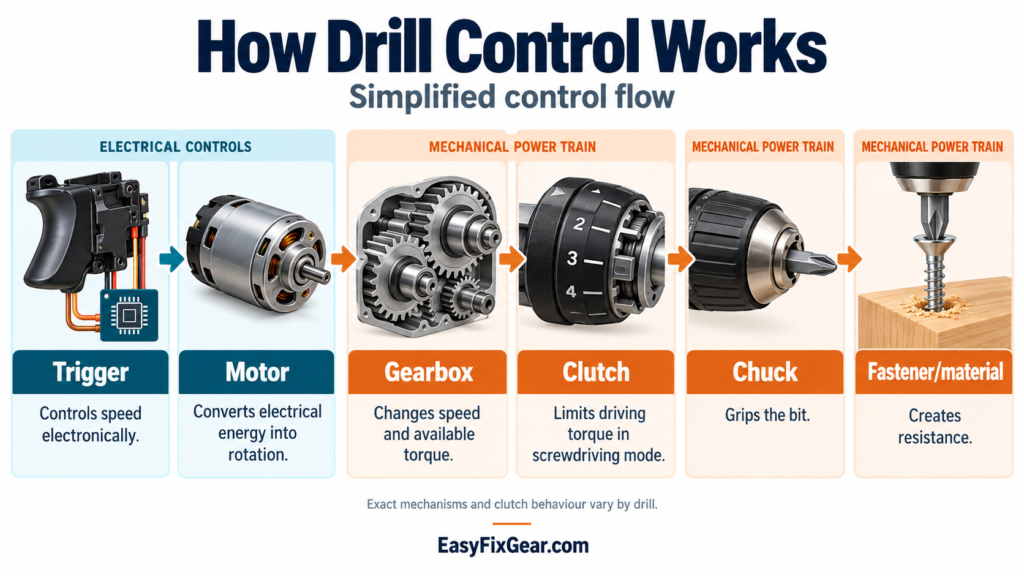
Cordless Drill Torque: Quick Answer
Torque is the turning effect a drill applies through its chuck and bit. Manufacturers commonly express it in newton-metres, or Nm.
A higher torque rating can indicate greater turning capability under the stated test conditions. It does not automatically mean better screwdriving control, faster drilling or greater suitability for your home.
| Specification | What It Means | Why It Matters |
|---|---|---|
| Torque (Nm) | Rotational turning effect | Helps overcome resistance from fasteners and cutting tools |
| RPM | Revolutions per minute | Describes rotational speed |
| Clutch | Adjustable screwdriving torque limiter | Helps prevent over-tightening and material damage |
| Gear | Mechanical transmission setting | Changes the available speed and torque relationship |
| Voltage | Battery system’s electrical voltage | Identifies a tool class, not a torque guarantee |
| Battery Ah | Battery charge capacity | Helps assess potential runtime; does not directly specify torque |
| Chuck | Holder that grips the bit | Determines compatible shank sizes and affects bit retention |
| Hammer mode | Rotation with axial percussion | Enables suitable masonry work within the tool’s capability |
Choose the drill for the job, then compare its complete specifications.
What Is Torque on a Cordless Drill?
Torque is a rotational turning effect.
Imagine tightening a bolt with a spanner. Your hand applies force through the spanner’s handle, creating torque around the bolt. A drill produces a similar turning effect through its motor, transmission, chuck and bit.
A screw needs enough torque to overcome resistance as it enters the material. A drill bit needs enough torque to keep cutting rather than stopping under load.
However, more available torque doesn’t mean every task should use it. A small cabinet screw can be damaged long before a powerful drill reaches its advertised maximum.
What Does Nm Mean on a Drill?
Nm means newton-metre, conventionally written N·m.
Conceptually, one newton of force applied perpendicular to a one-metre lever produces one newton-metre of torque. NIST identifies the newton-metre as the SI unit used for torque. Source: NIST torque guidance.
Nm is a physical unit, not a universal drill performance score. Keep these quantities separate:
- Nm: turning effect.
- Watts: power, or how quickly energy is transferred.
- RPM: rotational speed.
- Volts: electrical voltage.
- Ah: battery charge capacity.
Mechanical rotational power depends on torque and rotational speed together. Consequently, a maximum torque figure alone cannot describe how quickly a drill performs useful work.
Torque vs RPM: What’s the Difference?
Torque describes turning effect; RPM describes rotational speed.
Different jobs need different combinations:
| Job | Useful approach |
|---|---|
| Driving a large screw | Controlled speed with enough available torque |
| Drilling a small hole | Higher speed may suit the bit and material |
| Using a large-diameter wood bit | Often lower speed with greater torque reserve |
| Drilling metal | Speed matched to metal, bit type and diameter |
These are starting principles, not universal operating settings. Follow the drill and bit manufacturers’ instructions.
Also distinguish no-load RPM from working speed. A specification measured with the chuck spinning freely does not tell you exactly how much speed the tool maintains while cutting.
Pulling the trigger lightly reduces speed, but it does not mechanically change the gearbox ratio.
Gear 1 vs Gear 2 on a Cordless Drill
On many two-speed drill/drivers:
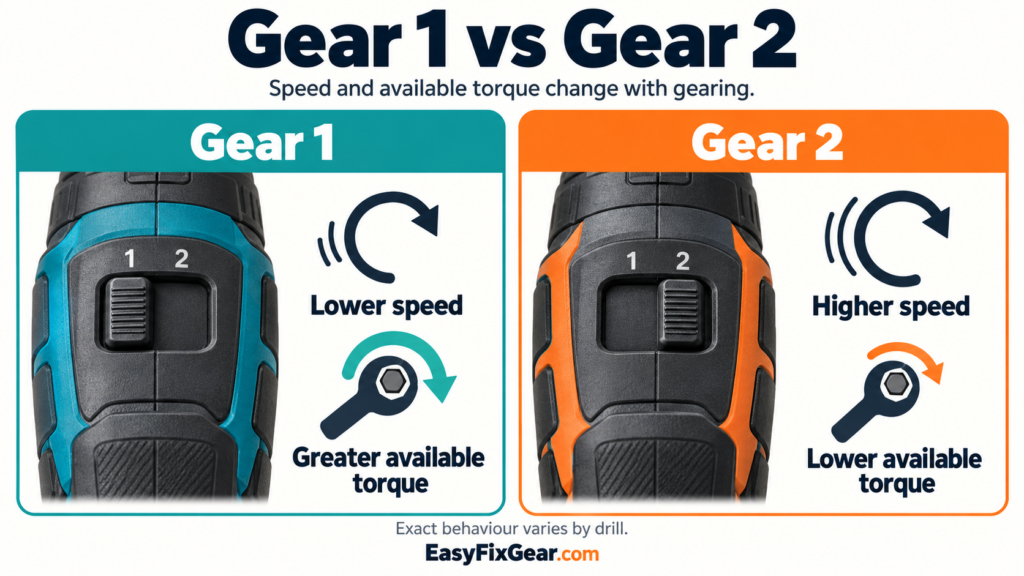
- Gear 1: lower speed and greater available torque.
- Gear 2: higher speed and lower available torque.
Makita’s XFD13 manual describes this relationship explicitly. Its low setting suits heavier loading; its high setting suits lighter loading. Source: Makita XFD13 instruction manual.
Gear 1 is often useful for screwdriving and larger drilling loads. Gear 2 may suit smaller bits where the recommended cutting speed is higher.
Exact ratios and recommended applications vary. Some drills have three gears.
Stop the tool before shifting and engage the selector fully, as instructed in the manual. If the drill struggles, check the bit, gear, material and rated capacity instead of simply pressing harder.
What Does the Drill Clutch Actually Do?
The numbered collar behind the chuck usually adjusts the screwdriving torque limitation.
Settings such as 1, 5, 10 and 20 generally do not mean 1 Nm, 5 Nm, 10 Nm and 20 Nm. They are normally relative positions for that particular tool.
A conventional mechanical clutch slips when resistance reaches its selected level. Some drills use electronic control that stops driving instead. For example, Bosch documents a Precision Clutch that stops the application tool when its selected threshold is reached. Source: Bosch GSR/GSB 18V-90 C manual.
The clutch can help reduce:
- Screws driven too deeply.
- Over-tightening.
- Stripped screw heads or damaged threads.
- Damage to furniture panels and other delicate material.
It cannot compensate for the wrong bit, poor alignment or excessive speed. It is also not a calibrated torque wrench for fasteners requiring a specified tightening torque.
More numbered positions may provide finer adjustment, but the number of settings does not establish the drill’s maximum torque.
How to Choose a Clutch Setting
Use a trial-and-adjust method:
- Select screwdriving mode and a lower clutch setting.
- Use the correct, snug-fitting driver bit.
- Drive slowly, preferably testing on matching scrap material.
- If the clutch activates before the screw seats, increase one step.
- Repeat until the fastener seats correctly.
- Stop increasing once the result is right.
Makita recommends driving a trial screw in the material or a duplicate piece to determine the required setting. Source: Makita XFD13 manual.
The appropriate setting depends on screw size and length, material, pilot hole, bit fit, drill and desired depth.
If resistance suddenly rises or the bit slips in the screw head, stop and investigate. A higher setting is not always the solution. For delicate assembly, finishing by hand can provide useful control.
Clutch Mode vs Drill Mode
Many drill/drivers have a drill-bit symbol on the collar or a separate mode selector.
In drill mode, the screwdriving torque limiter is commonly bypassed or its behaviour changes. Makita’s XFD13 manual states that its clutch does not operate at the drilling position. Source: Makita XFD13 manual.
This allows drilling without the screwdriving clutch repeatedly interrupting the cut. It does not mean the advertised maximum torque is continuously applied.
Do not automatically use drill mode for delicate screws: it removes an important layer of control. Overload protection and anti-kickback systems, where fitted, serve different purposes from the screwdriving clutch.
What Does Hammer Mode Do?
Hammer mode does not simply add more torque.
It adds rapid action along the bit’s axis while the bit rotates. This percussion helps suitable bits break up masonry.
The tool categories differ:
| Tool | Main function |
|---|---|
| Drill/driver | Rotation for drilling and screwdriving |
| Hammer drill/driver, or combi drill | Adds percussion for suitable masonry applications |
| Rotary hammer | Dedicated hammer mechanism for more demanding concrete and masonry work |
Many rotary hammers use an electro-pneumatic mechanism and an SDS bit holder. Milwaukee documents this mechanism on its SDS-Plus rotary hammer. Source: Milwaukee rotary-hammer documentation.
A hammer drill/driver and rotary hammer are not interchangeable. Check the mechanism, bit system and rated drilling capacities.
How Torque Affects Screwdriving
Furniture assembly and cabinet hardware reward control. A screw seated neatly is more useful than a screw driven quickly through a panel.
General household screws require enough turning capability to overcome resistance. Longer wood screws and larger fasteners can impose greater loads, especially in dense material.
The result also depends on:
- Fastener diameter, length and thread design.
- Material and any existing hole.
- Appropriate pilot holes.
- Correct driver-bit fit.
- Gear, trigger speed and clutch setting.
- Straight alignment and tool control.
A powerful drill used aggressively can strip a recess, damage threads or crush material. Torque reserve becomes useful when paired with control.
A drill is one part of a practical household toolkit; suitable bits, clamps and measuring tools matter too. See EasyFixGear’s essential tools every homeowner should have.
Why Pilot Holes Matter
An appropriate pilot hole reduces the material that the screw must displace or cut. It can reduce driving resistance and splitting risk, particularly near an edge or in harder wood.
Pilot-hole dimensions depend on the screw, thread, material and fastener instructions. There is no single correct size for every wood screw.
A drill struggling with a screw may need better preparation rather than a higher Nm rating.
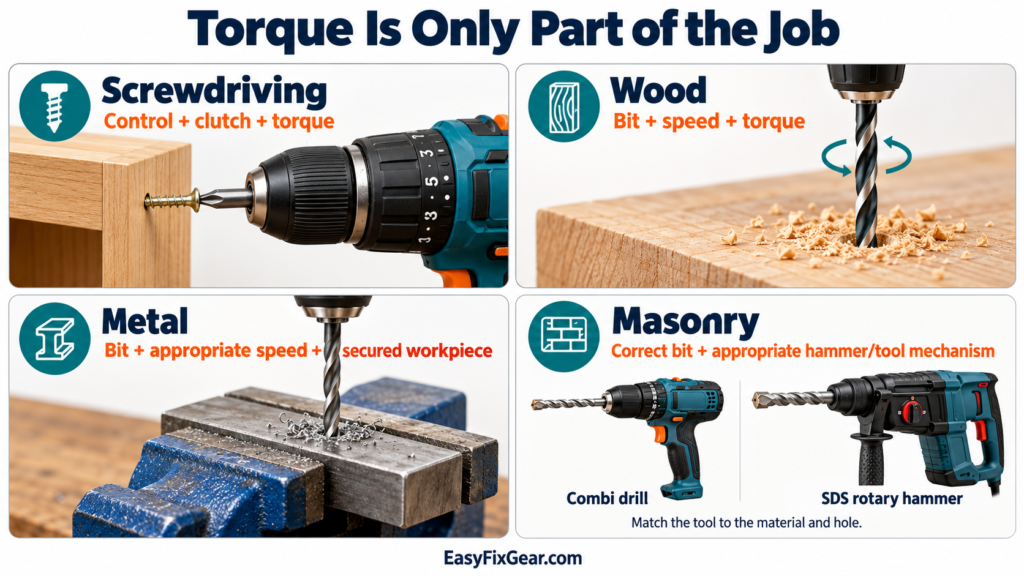
How Torque Matters When Drilling Wood
Wood-drilling demand depends on bit type, diameter, cutting condition and material.
A small twist bit, wide spade bit, Forstner bit and hole saw impose different loads. Larger cutting tools often demand more torque and lower operating speed, but follow their specific recommendations.
A sharp, suitable bit helps the drill cut efficiently. Dense hardwood, deep holes and clogged cutting edges can increase resistance.
Keep the operation within the drill’s capacity. A chuck accepting a bit’s shank does not prove the drill can safely drive that bit’s cutting diameter.
How Torque Matters When Drilling Metal
Metal drilling requires a suitable bit, appropriate speed and a secured workpiece.
Larger bit diameters generally call for lower rotational speed for a given metal and cutting tool. Torque must support cutting at that speed; spinning faster is not automatically better.
Clamp the work securely, especially small pieces that could catch and spin. Use cutting lubrication where specified for the metal and bit. Reduce feed pressure near breakthrough and wear eye protection. Source: CCOHS drill-safety guidance.
How Much Does Torque Matter for Masonry?
Masonry performance depends on more than Nm:
- Correct bit and compatible shank.
- Suitable hammer mechanism.
- Rotational speed.
- Blow rate and, where specified, impact energy.
- Material hardness and condition.
- Hole diameter and depth.
- Tool design and rated capacity.
A high Nm figure does not automatically make a standard drill/driver suitable for concrete.
A hammer drill/driver may suit some brick and light masonry jobs. Hard concrete, larger holes or repeated masonry work may require a rotary hammer. Bosch’s DIY guidance also directs users towards SDS tools for harder materials and larger drilling demands. Source: Bosch cordless-drill guidance.
Identify the substrate first. Indian homes can contain brick, blocks, plasterboard and reinforced concrete, sometimes within the same room. Plaster on the surface does not reveal what lies beneath.
Fragile or hollow masonry may require drilling without percussion, following the bit and fixing instructions.
Before drilling walls, check for concealed electrical wiring, plumbing and other services. Do not drill blindly through unexplained resistance or reinforcement.
Cordless Drill Torque for Typical Indian Home DIY
| Household task | Main consideration |
|---|---|
| Flat-pack furniture | Low-speed control, correct bit and conservative clutch setting |
| Cabinet handles and hinges | Gentle tightening and accurate positioning |
| Shelves | Separate drilling requirements from screwdriving requirements |
| Curtain brackets | Identify the wall material and use suitable fixings |
| Wood drilling | Match bit diameter, speed and available torque |
| Metal drilling | Correct bit, suitable speed and secure clamping |
| Brick walls | Suitable masonry bit, tool and percussion choice |
| Concrete walls | Assess rotary-hammer suitability rather than Nm alone |
Installing a shelf involves several decisions: making holes, selecting suitable anchors and tightening fasteners. Maximum drill torque does not determine the fixing’s safe load.
For frequent masonry work, prioritise tool type and hammer capability. For occasional concrete drilling, hiring or borrowing a suitable rotary hammer may be more practical than buying an oversized drill/driver.
How Much Cordless Drill Torque Do You Actually Need?
There is no dependable universal Nm threshold for every household task. EasyFixGear’s practical recommendation is to match capability to your work.
Light household work
For furniture assembly, cabinet screws and small repairs, prioritise:
- Compact size and comfortable handling.
- Predictable low-speed response.
- Useful clutch adjustment.
- Suitable bits.
Buying extra maximum torque offers little benefit if the drill is awkward or difficult to control.
General DIY
For routine wood drilling, general screwdriving and mixed projects, look for balanced capability: two-speed gearing, good trigger control, an appropriate chuck and documented drilling capacities.
Shelves and brackets may add masonry requirements, depending on the wall.
More demanding DIY
Larger bits, long fasteners and frequent work benefit from greater torque reserve, suitable gearing and adequate tool-and-battery capability.
Also assess handles, protective electronics and heat management. Masonry demands may justify a hammer drill/driver or rotary hammer rather than simply a higher-torque drill.
Why Maximum Advertised Torque Isn’t the Whole Story
A maximum torque figure describes a particular measurement, not the drill’s complete working behaviour.
Check these factors:
Measurement method and application. Is the figure hard torque, soft torque, maximum torque or another measurement? Are test conditions or a standard identified?
Gear used. A figure achieved in low gear does not establish high-gear capability.
Battery configuration. The pack used for testing may differ from the kit battery. Bosch’s GSR/GSB 18V-90 C manual identifies a GBA 18V 5.0Ah battery and a temperature range for specified measurements. Source: Bosch technical data.
Motor and electronics. These influence response to loading, current delivery and protective shutdown.
RPM under load. A drill needs to maintain useful cutting speed, not merely achieve a high turning figure.
Thermal management. Heat affects repeated work. Bosch documents speed reduction or shutdown under certain overload or temperature conditions on the same models. Source: Bosch operating instructions.
Control and mechanical design. Trigger behaviour, clutch, chuck retention and handling affect actual results.
Peak versus sustained performance. A maximum value should not be treated as continuously available during every job.
Therefore, 65 Nm from one manufacturer cannot automatically be assumed to outperform 55 Nm from another in every application.
Different reporting methods do not establish misleading advertising. They establish a need to read the labels and conditions carefully.
For another example, DeWalt explains its use of Unit Watts Out, a drill-system power measurement. UWO is not Nm and cannot be converted into a single torque value without corresponding rotational speed. Source: DeWalt UWO explanation.
Hard Torque vs Soft Torque
Some manufacturers publish separate hard and soft screwdriving figures.
Bosch’s consumer explanation describes soft screwdriving as resistance building gradually, such as when driving into wood. Hard screwdriving involves a much sharper rise in resistance, associated with rigid applications such as metal. Source: Bosch explanation.
The useful distinction is how resistance develops, not simply a label saying “wood” or “metal”.
These are not clutch modes to select. Nor is soft torque automatically a continuous-duty rating.
Reporting can be more detailed: Bosch’s GSR/GSB 18V-65 manual lists hard/soft screwdriving torque according to ISO 5393 separately from maximum torque. Metabo also publishes distinct soft and hard values. Sources: Bosch manual, Metabo specifications.
Do not assume every manufacturer’s “maximum” uses identical definitions or test conditions. Compare equivalent metrics where documentation allows.
Does Higher Voltage Mean More Torque?
Voltage does not equal torque.
A 12V-class tool may suit compact household work. An 18V-class platform often offers larger tools and broader capability, but actual torque depends on the motor, gearing, electronics and battery.
Likewise, “20V Max” does not automatically outrank “18V”. DeWalt states that its 20V Max battery designation represents maximum initial voltage without workload; nominal voltage is 18V. Source: DeWalt voltage footnote.
Compare the exact tools, not just voltage labels.
Does a Higher-Ah Battery Give More Torque?
Ah primarily describes charge capacity.
At the same voltage, greater capacity generally offers more potential runtime under comparable conditions. It does not automatically increase torque.
Keep these separate: voltage, capacity, runtime, power-delivery capability and tool output.
Pack cells, construction and electronics can affect performance. DeWalt, for example, documents increased output on a specific POWER DETECT drill with a specified battery pairing. That is a system-specific claim, not a universal Ah rule. Source: DeWalt POWER DETECT documentation.
Check recommended batteries and consider the weight penalty of a larger pack.
Does Brushless Mean More Torque?
Brushless technology can improve efficiency and offer useful electronic control and performance potential. Bosch identifies efficiency and reduced brush wear among its advantages. Source: Bosch motor guidance.
However, brushless does not automatically mean higher torque. A compact brushless drill and a larger brushed drill may have very different motors and gearing.
Compare actual specifications, capability and handling.
More Torque Also Means More Reaction Force
When a bit binds, or a fastener stops suddenly, the drill body can react against your hands. Greater available torque can make that reaction harder to control.
Use a secure grip, stable stance, suitable gear and a correctly fitted bit. Secure movable workpieces and use the side handle where supplied or required. Release the trigger if the tool binds. Disconnect power before dealing with a jam or changing bits. Source: CCOHS drill safety.
Some tools include anti-kickback features. Hilti’s Active Torque Control uses sensors and a braking system to reduce uncontrolled rotation when a bit jams. These features support safe handling; they do not replace it. Source: Hilti ATC.
Wear eye protection. Use hearing protection and appropriate dust control where required. Before wall drilling, check for hidden services; a detector is an aid, not a guarantee that drilling is safe.
Common Cordless Drill Torque Mistakes
Avoid:
- Choosing solely by maximum Nm.
- Treating clutch numbers as Nm.
- Using Gear 2 for every load.
- Using drill mode for delicate screws.
- Thinking hammer mode simply increases torque.
- Assuming voltage or Ah directly determines torque.
- Ignoring bit choice and fit.
- Skipping an appropriate pilot hole.
- Using an unsuitable tool for hard concrete.
- Ignoring torque reaction.
When performance is poor, check the setup before blaming the torque rating.
Cordless Drill Torque Myths
| Myth | Reality |
|---|---|
| More Nm always means a better drill | Suitability and control depend on the task |
| Torque and RPM are the same | One describes turning effect; the other speed |
| The highest clutch number equals maximum Nm | Clutch numbers usually represent relative settings |
| Gear 2 is more powerful than Gear 1 | It generally trades available torque for higher speed |
| High torque guarantees good concrete drilling | Concrete needs an appropriate bit and hammer mechanism |
| 20V automatically beats 18V | Maximum and nominal voltage naming can differ |
| Bigger Ah automatically means more torque | Capacity and power-delivery capability are different |
| Brushless always means more torque | Complete tool design determines output |
| Maximum torque is continuously available | Maximum ratings describe stated measurement conditions |
How to Compare Cordless Drill Specifications Properly
| Specification | Why It Matters | What to Look For | Common Mistake |
|---|---|---|---|
| Maximum torque | Indicates measured turning capability | Definition and test conditions | Ranking by Nm alone |
| Hard/soft torque | Describes different loading behaviour | Equivalent published metrics | Mixing hard, soft and maximum values |
| RPM | Affects suitable cutting speed | Gear ranges; no-load label | Assuming listed speed is maintained under load |
| Gearbox | Matches speed to load | Suitable mechanical gears | Using high gear universally |
| Clutch | Helps control screwdriving | Useful adjustment and clear operation | Reading settings as Nm |
| Chuck | Holds compatible bits | Shank capacity and secure retention | Confusing chuck size with cutting capacity |
| Hammer mode | Adds masonry capability | Mechanism and rated applications | Equating combi drills with rotary hammers |
| Voltage class | Defines platform | Exact model capability | Treating voltage as torque |
| Battery | Affects runtime, weight and system performance | Compatible pack and charger | Comparing Ah alone |
| Weight | Affects handling | Weight with intended battery | Comparing bare-tool weights only |
| Motor type | Influences efficiency and design | Whole-tool performance | Assuming brushless guarantees superiority |
| Warranty/service | Supports ownership | Indian warranty and accessible service | Assuming overseas terms apply |
| Battery ecosystem | Affects future purchases | Exact compatibility and availability | Assuming all same-voltage packs fit |
Choosing a Cordless Drill: Look Beyond Nm
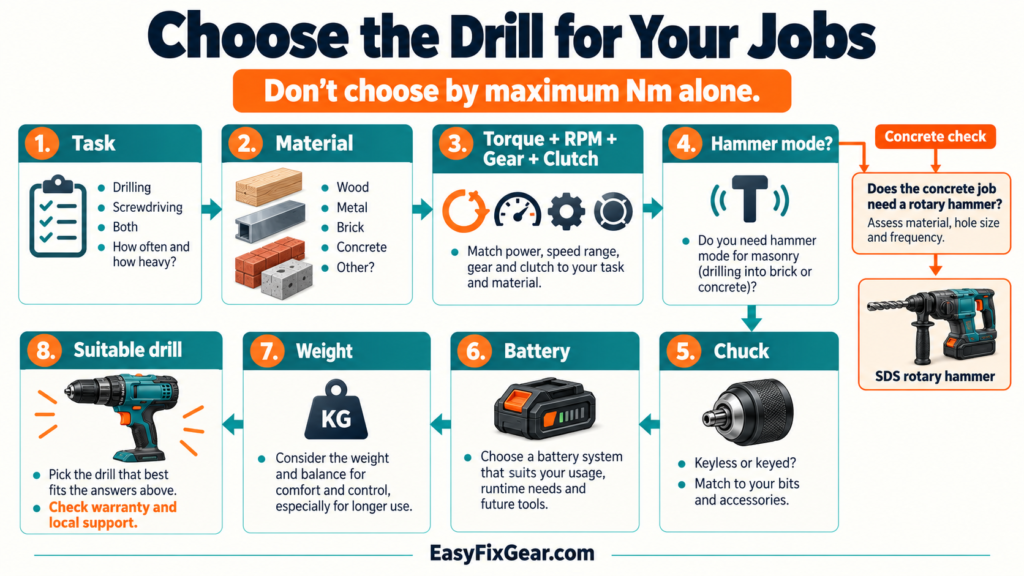
Follow this sequence:
Jobs → mostly screwdriving or drilling → materials → bit and fastener sizes → hammer requirement → torque, RPM, gears and clutch → chuck → battery ecosystem → weight and ergonomics → warranty and support → suitable drill.
For masonry, decide whether a combi drill is appropriate or a rotary hammer is needed.
For mobility versus sustained use and mains power, read about cordless vs corded drills.
Once you understand the specifications, compare EasyFixGear’s best cordless drills for home use in India against your actual tasks.
Frequently Asked Questions
What is a good torque for a cordless drill?
One that supports your intended work alongside suitable speed, gearing, control and rated capacities. No single Nm value suits every homeowner.
What does Nm mean on a drill?
Nm means newton-metre, a unit of torque describing rotational turning effect.
Is higher torque better?
It can help with demanding loads, but does not automatically improve handling, delicate screwdriving or drilling suitability.
What do drill clutch numbers mean?
They generally represent relative torque-limiting settings for that drill. They are not usually Nm values.
What is the difference between torque and RPM?
Torque is the turning effect. RPM is rotational speed. Useful drilling performance depends on both.
Which drill gear has more torque?
On many two-speed drills, Gear 1 offers greater available torque at lower speed. Check your manual.
How much torque do I need for screwdriving?
It depends on the screw, material and preparation. Start with a low clutch setting and increase until the screw seats correctly.
Does concrete drilling require more torque?
Torque matters, but concrete also requires suitable bits and an appropriate hammer mechanism. Hard or demanding concrete work may need a rotary hammer.
Does a higher-Ah battery increase torque?
Not automatically. Ah describes capacity; performance changes depend on the particular tool-and-battery system.
Is maximum torque the most important drill specification?
It is useful, but should be assessed with tool type, RPM, gearing, clutch, capacities, battery and handling.
Cordless Drill Torque: What Really Matters?
Nm describes rotational turning effect. Gears change the speed-and-torque relationship. The clutch helps limit screwdriving torque, while RPM describes rotational speed.
The material and task determine which combination is useful.
Understanding cordless drill torque helps you choose and use a drill intelligently. Maximum advertised torque is valuable information, but the best household drill is the one whose complete capabilities match your work.